Car profile — 2026 season
Audi R26.
Audi's first works Formula 1 car arrives with a radically reimagined sidepod, a homegrown Neuburg hybrid, and a brief that stretches a decade beyond its debut season.
A manufacturer's opening statement
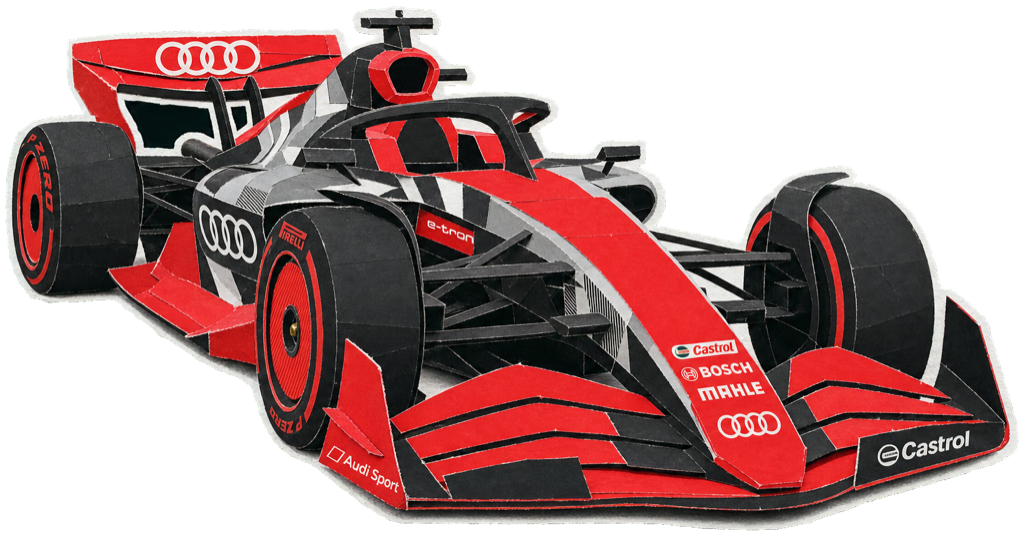
The R26 is the most consequential car Audi has ever built without a roof. It is the first machine of Audi's full works Formula 1 project, born out of the gradual acquisition of the Sauber team at Hinwil and a fresh power-unit operation at Neuburg an der Donau in Germany 12. Unveiled on 20 January 2026 at the Kraftwerk in Berlin, it carries a number — 26 — that nods both to the season and to the regulatory year-zero it was conceived for 13. Audi's brief was unusually long-range: compete in 2026, but build the foundations to win a championship by 2030 4.
That ambition collided with the biggest rules reset in a generation. The 2026 cars are narrower (1,900mm versus 2,000mm) and lighter, with active front and rear wings that toggle between a high-downforce Z-mode and a low-drag X-mode, 1.6-litre V6 turbo-hybrids splitting power roughly 50/50 between combustion and electric, no MGU-H, an MGU-K up to 350kW, and 100% sustainable fuel 3. For Audi, doing all of this for the very first time — as a brand-new engine manufacturer — was a steep climb.
“Reliability, too, bit hard, with Hülkenberg's Barcelona race ending through an unusual technical failure.”
The most distinctive car on the grid
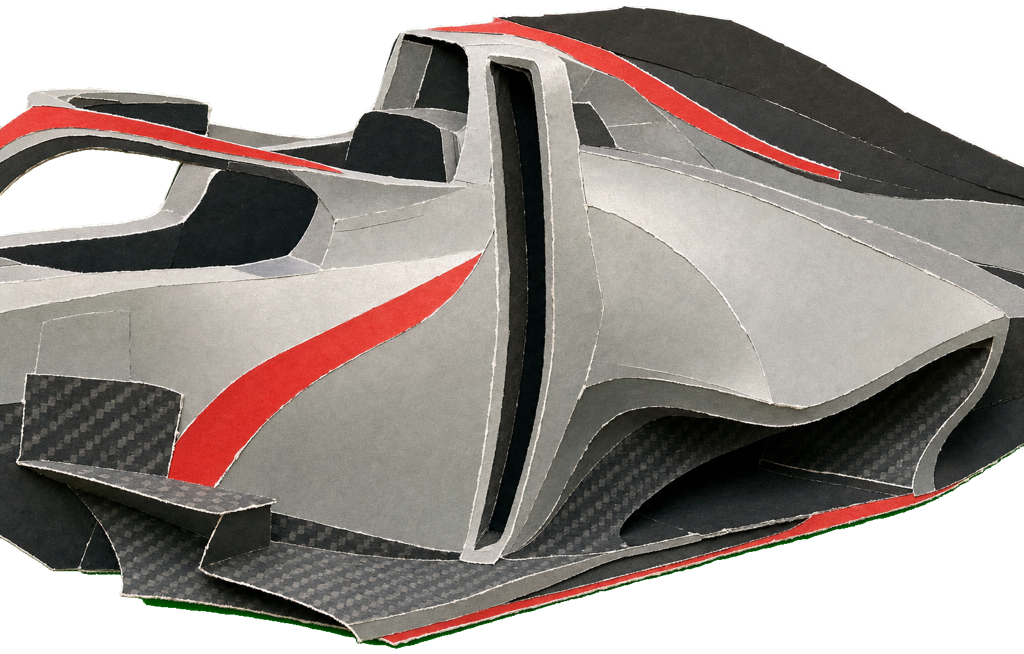
Where most rivals took an evolutionary path into the new rules, Audi went radical. The R26 emerged from Bahrain testing as one of the grid's most distinctive designs, and the talking point was its sidepods 56. Audi adopted an 'inverted' air-intake layout, stretched far forward and running almost vertically up the side of the chassis rather than the conventional wide horizontal slot 6. The result is a dramatically narrow front profile and a large volume of free space alongside the bodywork for flow management 6.
The shaping is intricate. A slim lower front transitions into a wider upper body in a two-tier arrangement, with a gentle gulley channel pressed along the top surface and a 'pelican-style' G-line sweeping down the flank into a deep undercut 6. The rear of the pod slopes steeply down to feed air onto the floor edges, and the whole mid-section is set up to drive outwash and bias downforce generation towards the front of the floor — with the nose, T-tray and bib all revised to suit 57. Formula1.com called it a 'highly unusual aerodynamic route' 7. It was a deliberate statement: as a full manufacturer with new freedoms, Audi chose to stand out rather than play safe 57.
Built in Hinwil and Neuburg
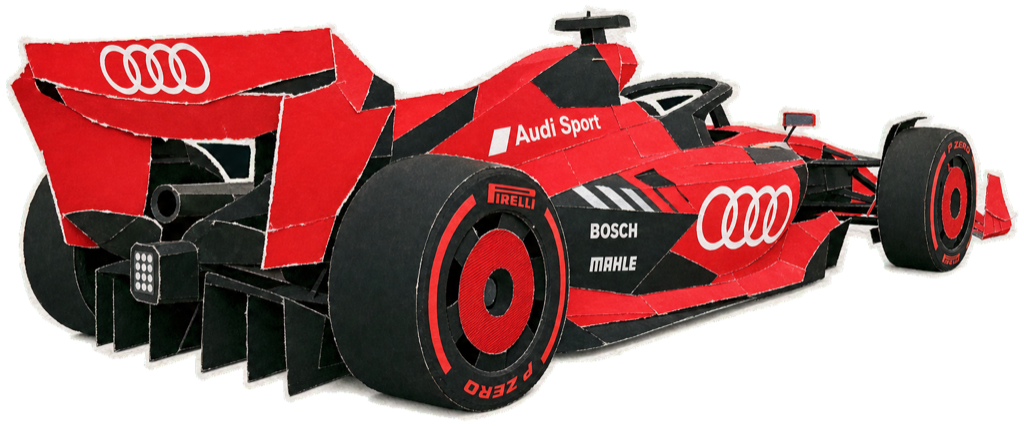
Underneath the bodywork, the R26 is a thoroughly conventional carbon-fibre survival cell — a moulded composite monocoque with honeycomb structure, integrated safety cells and an ATL fuel bladder 2. Suspension is double wishbone front and rear, pushrod-activated, with inboard torsion springs and Ohlins dampers 2. The eight-speed sequential gearbox is built in-house with a carbon maincase, braking comes from Brembo, and the car rolls on 18-inch APP Tech magnesium wheels wrapped in Pirellis 2. It is fuelled by bp's sustainable blend, with bp the exclusive fuel partner 12.
The heart of the project is the AFR 26 Hybrid, the first F1 power unit Audi has ever built, designed from a clean sheet at Neuburg 13. A 90-degree 1.6-litre V6 (80mm bore, 53mm stroke) is paired with an MGU-K that triples kinetic recovery versus the old era and, in the absence of DRS, deploys its electric punch through a push-to-pass 'boost mode' 23. The unit fired up in the chassis at Hinwil on 19 December 2025, with a shakedown at Barcelona on 9 January 2.
A competitive chassis, an honest power gap
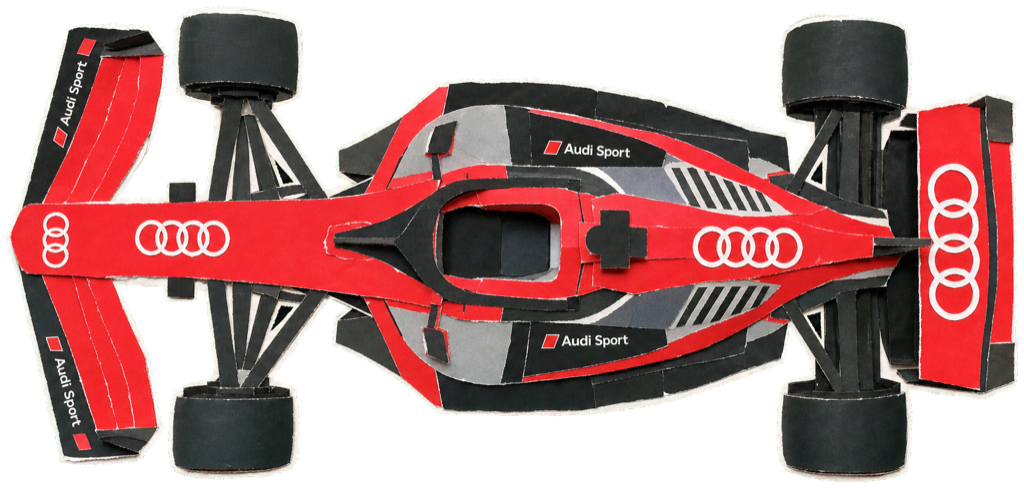
The livery matched the ambition: titanium silver, bare carbon fibre and 'Lava Red', with Revolut as title partner and a palette Audi says stands for clarity, technology, intelligence and emotion 18. On track, the debut delivered an immediate headline — Gabriel Bortoleto qualified tenth and finished ninth at the season-opening Australian Grand Prix, scoring Audi's first points as a works team 9. Teammate Nico Hülkenberg, the experienced German anchor of the line-up, was less fortunate, unable to take the start in Melbourne due to a technical issue 9.
The pattern of the early season became clear quickly: a genuinely competitive chassis hamstrung by a power deficit. Bortoleto repeatedly qualified inside the top 11, but on Sundays the car was 'always chasing on the straights' 10. Both drivers were candid. 'We're not the most powerful power unit out there. We definitely have a deficit,' Hülkenberg admitted, while Bortoleto noted 'our chassis looks in a good place... but with the engine, we can see the lack of power' 10. Speed-trap data at Miami told the story — roughly 319 km/h to Mercedes' 334 km/h 10. Reliability, too, bit hard, with Hülkenberg's Barcelona race ending through an unusual technical failure 11.
Off-track there was turbulence as well: Team Principal Jonathan Wheatley, who had fronted the launch, departed just two rounds into the season, with Head of F1 Project Mattia Binotto absorbing the role and James Key continuing as Technical Director 12. For all the growing pains, Audi's first works car did exactly what a first works car should — it scored on debut, looked unlike anything else on the grid, and gave its engineers a clear, honest target: find the power, and the rest of the package may already be there 10.
Key innovations
Designers & engineers
Sources & further reading
- Premiere in Berlin: Audi Revolut F1 Team officially unveiled — Audi MediaCenter
- Audi R26: Technical Specifications — Audi Revolut F1 Team Content Hub
- FIRST LOOK: Audi reveal their new car for 2026 F1 season — Formula1.com
- Audi Formula 1 team reveals 2026 livery, targets title by 2030 — ESPN
- Audi takes radical approach with 2026 sidepods in Bahrain F1 test — Autosport
- Tech analysis: Audi F1's eye-catching sidepods explained — PlanetF1
- TECH WEEKLY: How Audi have taken a highly unusual aerodynamic route with the R26 — Formula1.com
- Audi reveals striking silver livery for 2026 debut F1 car — Motorsport.com
- Audi R26 — Wikipedia
- Audi F1 engine 'just lacks power' — Gabriel Bortoleto — Motorsport.com
- The unusual and unfortunate reason why Hulkenberg's race in Barcelona came to an abrupt end — Formula1.com
- Audi F1 team principal decision: Mattia Binotto explains Jonathan Wheatley exit stance — PlanetF1
Car renders are interpretive illustrations created for EXPO KINETIC, not photographs — approximate, for editorial use, not technical reference.