Car profile — 2026 season
Williams FW48.
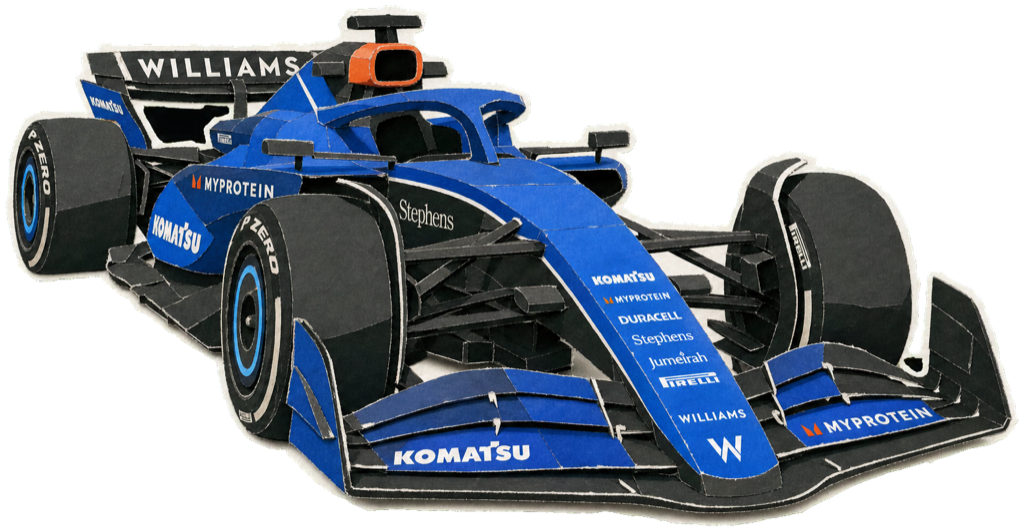
Grove's all-in bet on Formula 1's 2026 reset — a Mercedes-powered, pullrod-front Williams that arrived heavy and late, but with Sainz and Albon to drag its potential out of it.
The brief: be first to the future
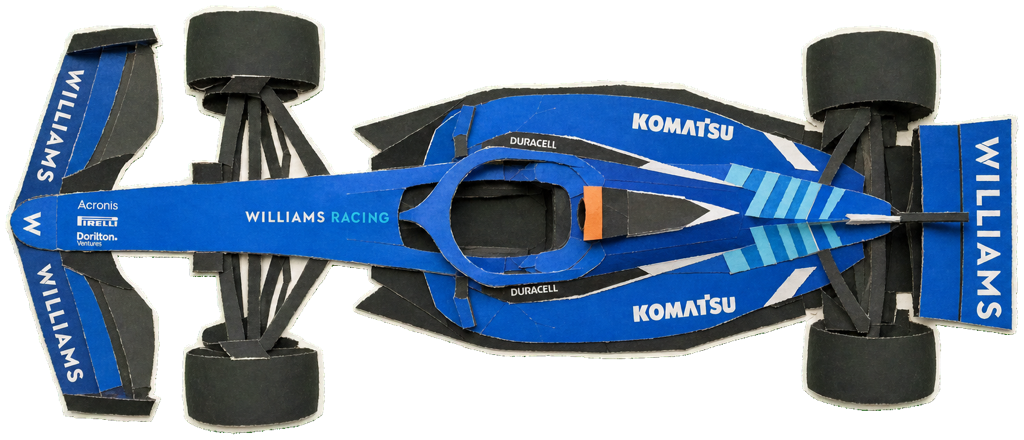
For Williams, 2026 was never really about 2025. The Grove team made one of the boldest strategic calls on the grid by switching its full design effort to the new rules from 1 January 2025, halting development of the 2025 FW47 early to throw everything at the FW48 13. The logic was simple and aggressive: the 2026 reset is the biggest in a generation — smaller, lighter cars on a 1900mm-wide footprint, active aerodynamics, and all-new 1.6-litre V6 hybrids running a roughly 50/50 combustion-electric split with the MGU-H gone and the MGU-K cranked up toward 350kW on 100% sustainable fuel 68. Get the concept right first, the thinking went, and a team that finished a creditable fifth in the 2025 constructors' fight could keep climbing. James Vowles framed the whole project as "the next step on the path back towards the top" 9.
A difficult birth at Grove
The reality was harder than the plan. The FW48's gestation was, by the team's own admission, troubled: four failed crash tests and a very late FIA chassis homologation left Williams chasing the calendar, and the car missed the private Barcelona shakedown in late January 2026 13. It was the last 2026 car to break cover, with its livery revealed on 3 February and a first run at Silverstone the following day before testing proper began in Bahrain on 11 February 12. The most public scar of that rushed build was mass. Williams quoted a tidy launch figure of 772.4kg — just over the 768kg minimum — but the car was widely reported to be running closer to 28kg overweight in the real world 1237. In 2026's tightly capped weight world, that is enormous.
“The internal estimate was startling — up to a second a lap on the table once the car reached the limit.”
Turning ballast into lap time
What separates the FW48 story from a simple tale of woe is how Williams chose to frame the problem. Rather than treat 28kg as dead loss, the team cast it as recoverable performance: trim the excess and you not only go lighter, you free up ballast to reposition for a better balance and lower tyre degradation. The internal estimate was startling — up to a second a lap on the table once the car reached the limit 3. Vowles was characteristically candid about why it couldn't all come off at once: "It's not complicated to bring it down... we've got to time it with when those components start to go out of life," he said, pointing at cost-cap and component-life constraints 3. A lighter chassis and new parts were timed across the season, with the weight programme targeted for completion around the Italian Grand Prix 13.
The engineering signatures
Under CTO Pat Fry and engineering director Matt Harman, with Adam Kenyon leading aerodynamics, the FW48 made some genuinely independent choices 12. The headline is suspension: Williams was the only team on the grid to pair a pull-rod front with a push-rod rear, one of just three cars to run a pullrod front at all 245. The pullrod front cleans up airflow behind the new narrower front wing and lowers the front roll centre; Vowles called it "slightly different" but deliberately less extreme than Aston Martin's Newey-influenced layout 45.
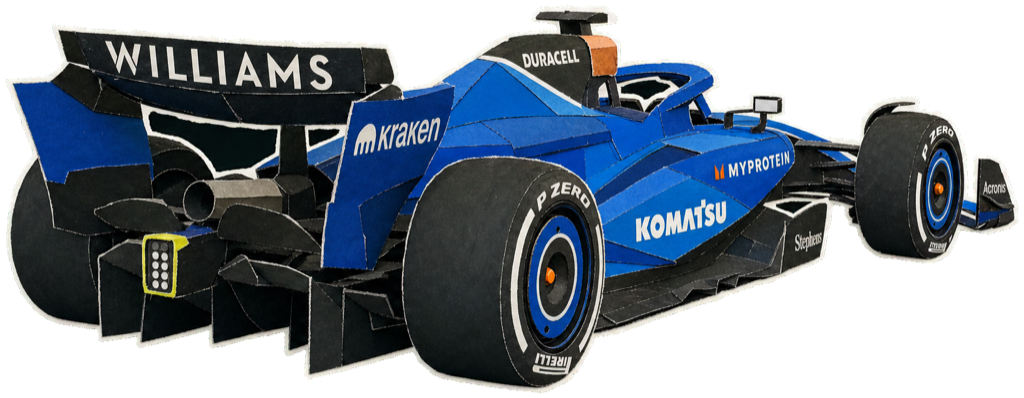
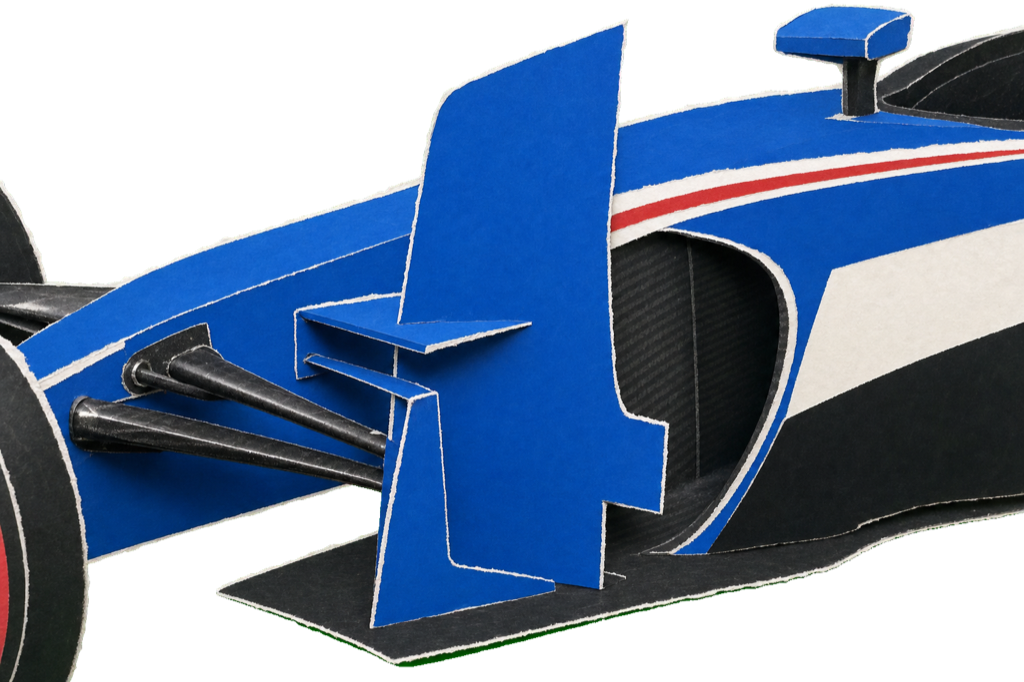
In the detail, the car's calling card is its floor furniture. At the Bahrain debut the FW48 appeared with a three-piece deflector "sail" — a tall main element, an L-shaped forward section and a slat between — distinguished by a deliberate bite cut out of the lower rear quarter to reshape the airflow, a clear point of difference from McLaren's broadly similar concept 11. Underneath, the team ran vortex generators on the bib-stay fairing, expanded "mouse hole" inlets to manage tyre squirt onto the diffuser, and a centreline chute feeding the diffuser's trailing edge 11. Like every 2026 car it deploys active aero — driver-selectable X-mode for low drag and Z-mode for downforce, across three-element front and rear wings with no beam wing 68.
The drivers and the season
The line-up was the team's biggest asset. Carlos Sainz, in his second Williams year and wearing #55, brought race-winning pedigree to lead the technical push; Alex Albon, #23 and in his fifth season at Grove, remained the established benchmark 2. The season ran true to the car: a heavy, willing machine that punched above its raw pace through its drivers. Albon's year began with a setback when a hydraulics problem ruled him out of the Chinese Grand Prix, but the team's first double-points haul arrived at Miami with both cars inside the top ten 3. As the weight came off through the European rounds, Sainz in particular strung together repeat points finishes, including a run of ninth places, keeping Williams in the midfield scrap while the bigger upgrades landed 12.
Where it sits
The FW48 is best understood as a deliberate down-payment. Williams sacrificed its present-tense competitiveness and accepted a painful, overweight launch in exchange for being early and committed on the rules that will define the next era. Whether that gamble pays off depends entirely on the diet — if Grove genuinely unlocks a second a lap by reaching the weight limit, a midfield car becomes something far more interesting. As a piece of engineering it is distinctive: the grid's lone pullrod-front/pushrod-rear split, a clever notched floor, and a Mercedes power unit that is among the best on the grid 26. It is, in Vowles' framing, the awkward but promising first car of a new Williams.
Key innovations
Designers & engineers
Sources & further reading
- Williams FW48 — Wikipedia
- Atlassian Williams F1 Team FW48 Technical Specifications — F1network.net
- The 28kg problem that gives Williams hope for a one-second gain in F1 2026 — Motorsport.com
- Williams confirms 'slightly different' suspension for 2026 after launch trick — PlanetF1
- Williams ends major longstanding F1 rumour with FW48 details — Motorsport Week
- What's New in Formula 1 for 2026? — Atlassian Williams Racing
- Williams publishes FW48 car weight after alarming F1 2026 scare stories — PlanetF1
- 2026 F1 Aerodynamics Explained: Active Aero, X-Mode and Z-Mode — F1 Chronicle
- Atlassian Williams F1 Team reveals bold new racing livery for 2026 — Williamsf1.com
- FIRST LOOK: Williams show off their new livery for 2026 F1 season — Formula1.com
- Williams FW48 debuts in Bahrain with breakthrough 2026 aero design — PlanetF1
- The state of play at Williams after three rounds of the 2026 season — Formula1.com
Car renders are interpretive illustrations created for EXPO KINETIC, not photographs — approximate, for editorial use, not technical reference.