Car profile — 2026 season
Mercedes W17.
The Silver Arrows turned Formula 1's biggest reset in a generation into a Brixworth-powered masterclass, building the benchmark car of 2026 around an all-new hybrid and a feud between two of their own.
A reset built to order
Formula 1 has rarely handed a team a cleaner blank page than 2026, and rarely has a team filled it as completely as Mercedes. The W17 E Performance was conceived for the sport's biggest rules upheaval in a generation: cars 100mm narrower, with wheelbases capped 200mm shorter, around 30kg lighter at a 768kg minimum, DRS swapped for movable front and rear wings, and an entirely new 1.6-litre V6 turbo-hybrid running a near-50:50 split between combustion and electrical power on 100% sustainable fuel 12. Technical Director James Allison framed the moment as Formula 1 distilled — "regulation changes are the lifeblood of Formula One innovation" — and pointedly promised his group would be "shameless plagiarists," copying any good idea on the grid rather than falling in love with their own 34.
That blend of ambition up front and pragmatism underneath is the W17's signature. Launched on 22 January 2026, it married a genuinely aggressive new power unit to a deliberately conservative chassis, and it worked from the first lap 15.
“Above the floor, Allison's team resisted the temptation to reinvent everything at once.”
The Brixworth advantage
If one component defines the car, it is the engine in the back of it. The Mercedes-AMG F1 M17 E Performance, built at the High Performance Powertrains base in Brixworth, is widely judged the benchmark of the 2026 power-unit reset 6. The 1.6-litre V6 is limited to 15,000rpm and fed by a single-stage turbocharger spinning to roughly 150,000rpm; the MGU-H has been deleted, and the MGU-K stepped up from 120kW to as much as 350kW, drawing on a lithium-ion store of up to 4.0MJ of usable energy 25. Get the energy-deployment strategy right and you carry electrical punch deep into every straight; get it wrong and you arrive at the next corner with a flat battery. Mercedes got it right, and the integration of that power unit with the W17's cooling and aerodynamics — the long-running "Brackley-Brixworth" partnership — gave the team a recharge-and-deploy edge rivals openly chased 6. Mercedes was also reported, alongside Red Bull Powertrains, to have found a regulatory gap allowing a higher compression ratio than the nominal figure, helping push thermal efficiency past 50% under the formula's tighter fuel-flow ceiling 1.
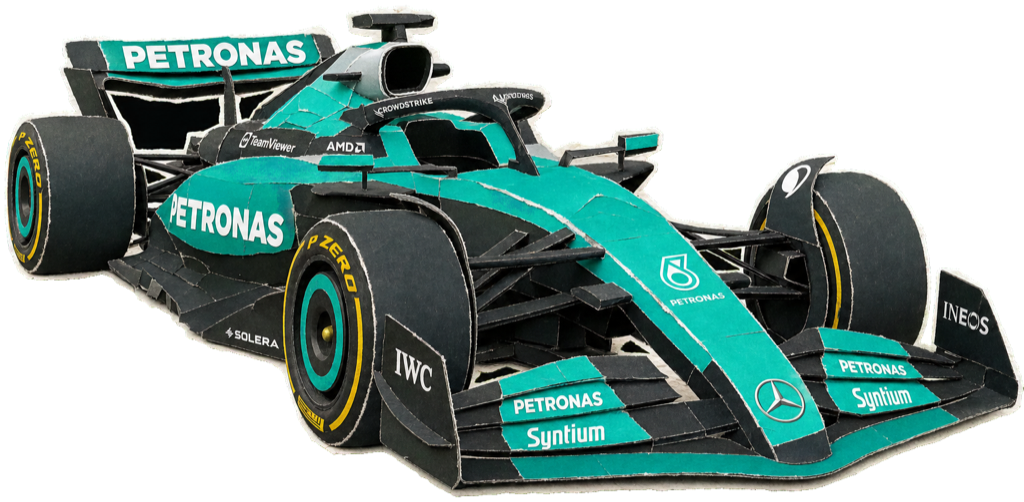
A clean car, cleverly detailed
Above the floor, Allison's team resisted the temptation to reinvent everything at once. The W17 keeps a proven pushrod front, pushrod rear suspension layout rather than gambling on exotic kinematics, concentrating its risk budget where it mattered most 7. Around the shorter wheelbase and narrower track, that gave a car with sharp turn-in and an unusually trustworthy platform from race one 7.
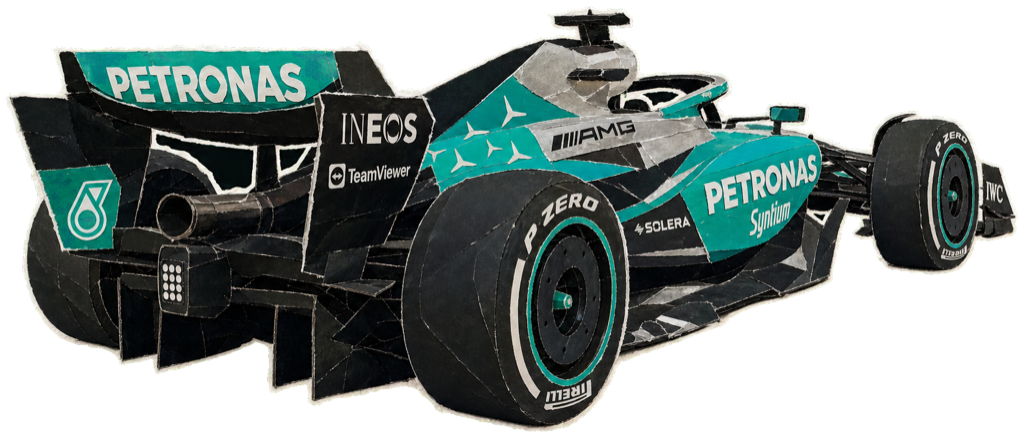
The detailing is where the engineering personality shows. Mercedes opted for one of the simplest active-aero solutions on the grid: only the uppermost element of the front wing rotates when the driver toggles between high-downforce "Z-mode" and low-drag "X-mode," pivoting across its full span, with the wing's support pillars mounted unusually on the second element rather than the mainplane 8. Most striking of all, the W17 abandons conventional front brake-duct inlet scoops entirely, instead drawing cooling air from the slim channel between the duct body and the inner sidewall of the new, narrower front tyre — a thermal idea once used only as a supplement, now promoted to the primary route, and quickly studied up and down the pit lane 8. The rear end is fussed over too, with a thinned endplate top edge and a notched rearmost corner to tame the tip vortex, and an enlarged diffuser "mouse hole" 8. Notably, the launch renders and the shakedown car differed in several details — a vane atop the footplate, a missing diveplane — a reminder that the real car is rarely the one shown on reveal day 8.
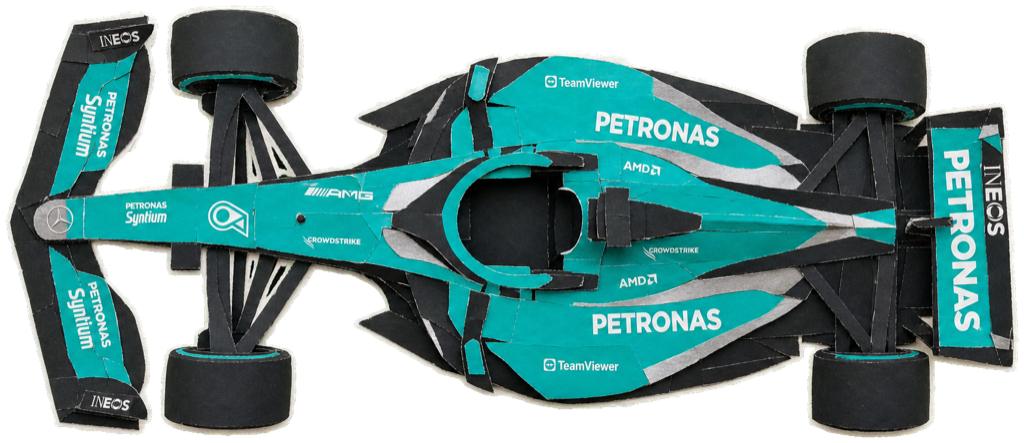
A season — and a rivalry — to remember
On track the W17 delivered immediately, and so did the human drama. George Russell, now the senior figure in his fifth Mercedes season, won the opening Australian Grand Prix to complete the team's 61st 1-2 finish 9. But the story of the year became his teammate. Kimi Antonelli, 19 and in only his second campaign, took his maiden win in China as the youngest polesitter in F1 history — bettering Sebastian Vettel by nearly two years — and stacked it into a pole-win-fastest-lap hat-trick 1011. Back-to-back victories in China and Japan made him the youngest championship leader the sport has seen, and a grand chelem in Monaco confirmed he was no fluke 1012. Russell answered with a controlled, pole-to-flag drive in Austria, holding off Max Verstappen for a Mercedes 1-3 with Antonelli third, closing some of the gap to his runaway teammate 1314.
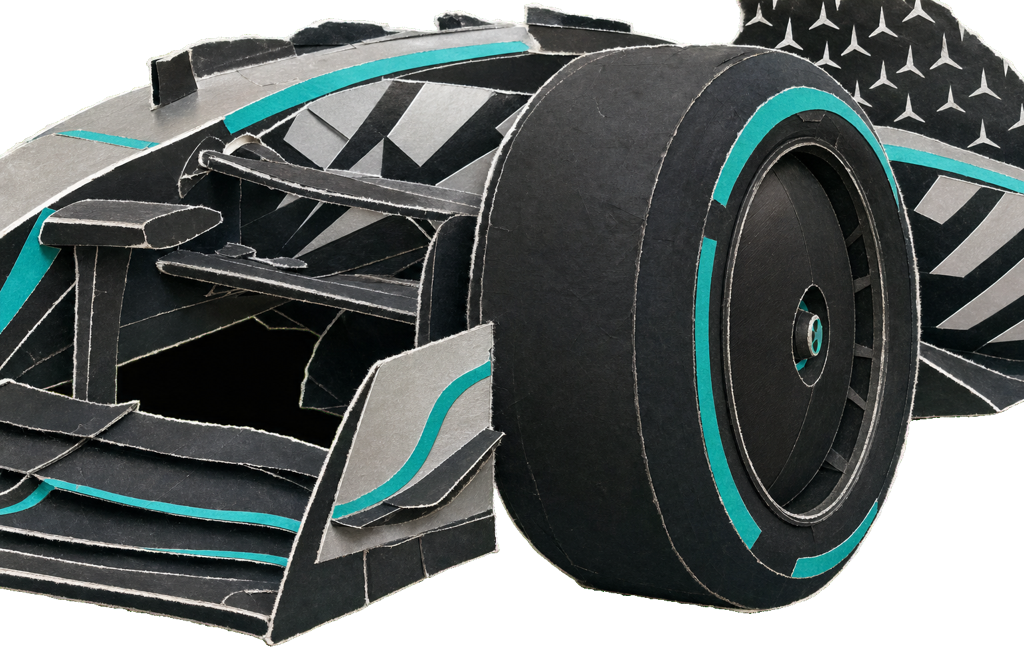
By the opening third of the season the W17 sat clear at the head of the Constructors' Championship, the in-house power unit looking like the era-definer Brixworth had built it to be 6. The only real threat to Mercedes, it seemed, was Mercedes — two of its own drivers contesting a title fight the team would have to referee for the rest of the year 15. After a decade defined first by total dominance and then by struggle, the W17 marked the Silver Arrows' return to the front of a brand-new Formula 1 — and on their own terms.
Key innovations
Designers & engineers
Sources & further reading
- Mercedes W17 — Wikipedia
- F1 W17: 2026 Technical Specifications — Mercedes-AMG PETRONAS F1 Team
- Mercedes-AMG PETRONAS F1 Team reveals its 2026 Challenger
- Mercedes F1 chief admits team will be 'shameless plagiarists' with 2026 car — GPFans
- Explore the Mercedes-AMG F1 W17 — Mercedes-AMG PETRONAS F1 Team
- Mercedes breaks cover on era-defining power unit in team celebration — PlanetF1
- The Mercedes W17: 2026 F1 Regulations and the McLaren Problem — Coffee Corner Motorsport
- Mercedes W17 F1 2026 shakedown exposes puzzling differences with launch car — PlanetF1
- Mercedes unveils W17 livery as new stripes draw mixed reaction — Motorsport.com
- Kimi Antonelli — Wikipedia
- Forget luck: Antonelli shows he's an F1 title threat in Japan — ESPN
- 'This fight is on': Mercedes will need to manage more Antonelli-Russell battles — ESPN
- Russell seals victory in thrilling Austrian Grand Prix ahead of Verstappen and Antonelli — Formula1.com
- 2026 F1 Championship standings: George Russell's Austrian GP win closes gap to Kimi Antonelli — Motorsport.com
- George Russell's breakthrough, Ferrari's setback as F1 title race shifts again at Austrian GP — ESPN
Car renders are interpretive illustrations created for EXPO KINETIC, not photographs — approximate, for editorial use, not technical reference.