Car profile — 2026 season
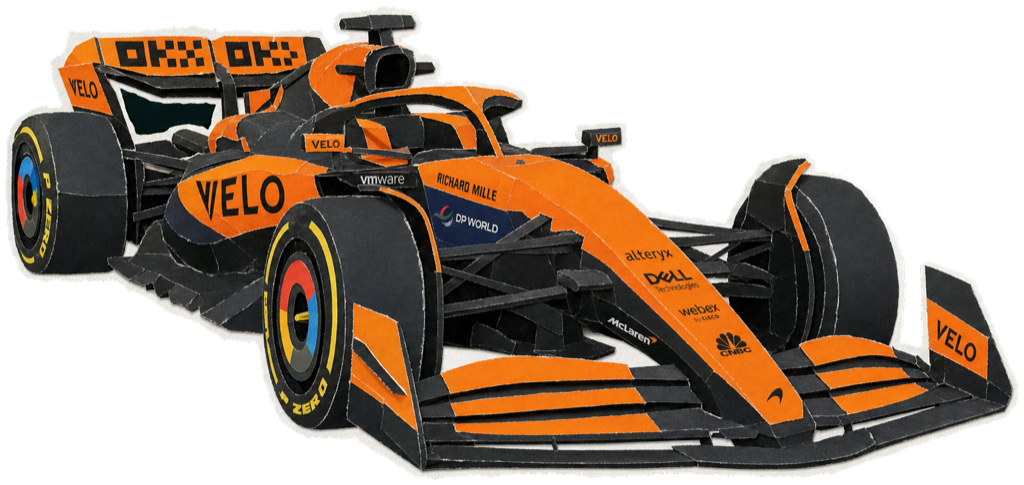
McLaren MCL40.
The reigning double champions' clean-sheet 2026 challenger — a tightly packaged, papaya Mercedes-powered car that returns to push-rod front suspension and spent the new-rules era's first half clawing back a deficit it never expected to have.
A title defence into the unknown
McLaren arrived at 2026 as the team to beat on form and the team with the most to lose. The Woking squad had just completed a worst-to-front turnaround crowned by back-to-back Constructors' titles in 2024 and 2025, with Lando Norris edging team-mate Oscar Piastri to the Drivers' crown by two points at the final round 12. For the first time since Jenson Button in 2010, the No. 1 would appear on a McLaren, Norris electing to carry it rather than revert to his familiar No. 4 3. But the MCL40 was not an evolution of a championship-winning car. It was a clean sheet, drawn against the biggest rules reset in a generation — and that reset would humble the champions.
The brief: a brutal repackaging job
The 2026 regulations shrank and lightened the cars (around 100mm narrower, some 30kg lighter, a 768kg minimum including driver), deleted the ground-effect tunnels in favour of a flatter floor and bigger diffuser, simplified the wings, and made both front and rear wings movable between a high-downforce cornering mode and a low-drag straight-line mode 45. Alongside it came an all-new Mercedes-AMG F1 M17 E Performance power unit: the same 1.6-litre V6 turbo but with the MGU-H deleted, a roughly 50/50 split between combustion and electric power, the MGU-K boosted to 350kW, and 100% sustainable fuel 46.
“Piastri described an MCL40 with "no real strengths," running at a deficit to Ferrari and Mercedes "in all facets".”
Chief Designer Rob Marshall framed the MCL40 as almost total reinvention — "every nut and bolt" differs from the MCL39, with "the whole floor operation completely different" and "the whole front of the car completely different" 7. Counter-intuitively, he stressed the regulations were more constrained, not less: with engine length and gearbox cluster fixed, only 150–300mm of car length was genuinely free to shape 4. Team Principal Andrea Stella called it "the biggest new-car project I have ever been part of" 4. The signature engineering flex was packaging — Marshall described fitting radiators and electronics into the shorter, lighter car as "brutal," and the team responded by spreading cooling across the airbox and engine cover to shrink the sidepod inlets to remarkable proportions 8.
The design story: push-rod, and an aero-led front end
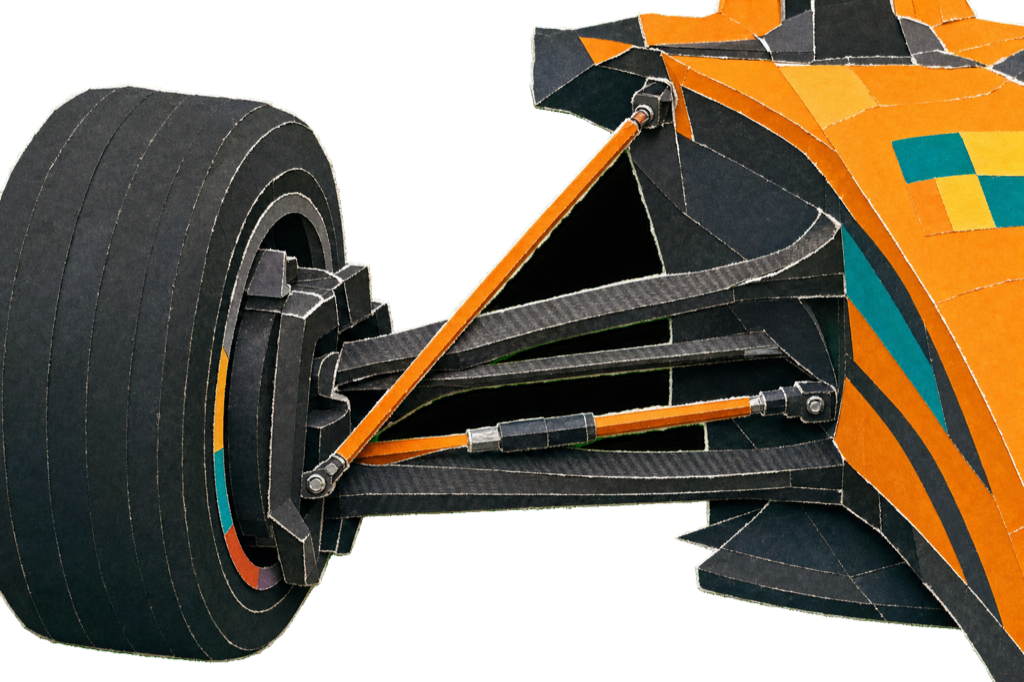
The most-discussed visual choice was a return to push-rod front suspension, abandoning the pull-rod front the MCL39 had run 9. Crucially, McLaren insisted the call was aerodynamic, not mechanical. Mark Temple, Technical Director for Performance, explained that push-rod versus pull-rod is "really an aerodynamic decision" about what suits the new front wing, with neither hard to do mechanically 910. Marshall said McLaren "pushed the boat out" on front-suspension mount-points and geometry, moving the steering arm ahead of the lower wishbone and adopting an unconventional, tightly raked layout to control the platform while chasing local aero gains 10. To an observer the front corner looks like a sharply angled spider of separated linkages ahead of a slim, drooped nose — a deliberately exposed statement of intent.
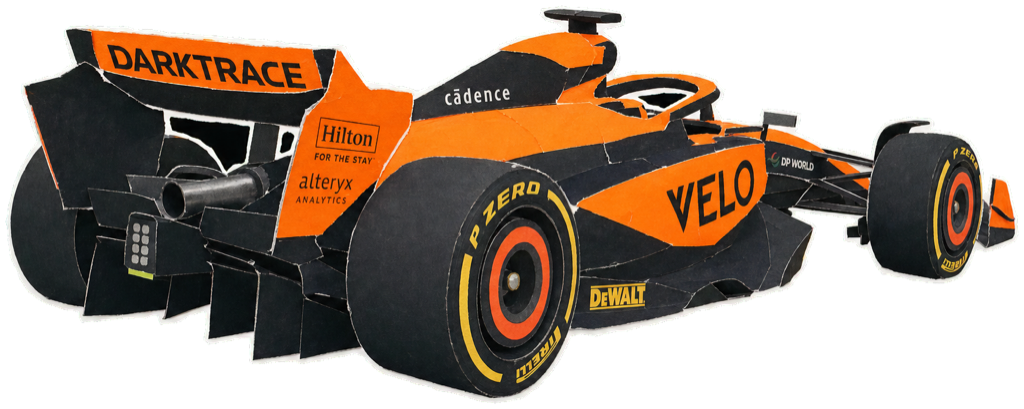
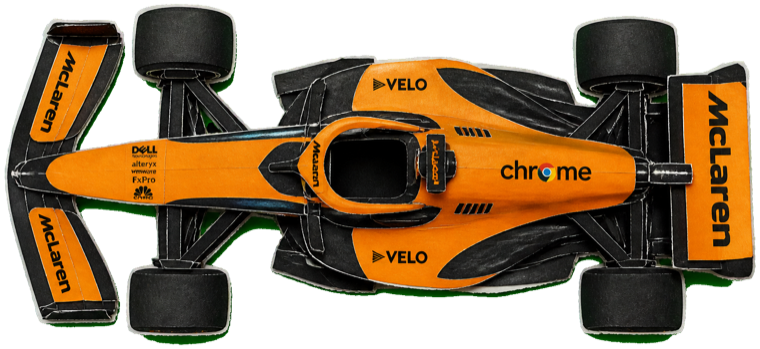
The rest of the package read as a careful study of the new envelope: push-rod rear as well, AP Racing brakes with carbon-carbon discs and electronic brake-by-wire at the rear, an eight-speed seamless-shift gearbox, Pirelli P Zero rubber on 18-inch Enkei wheels, and the familiar papaya livery — now with anthracite and small hints of teal, vinyl-wrapped rather than painted, carrying new title partner Mastercard 611.
The season: a humbling, then a recovery
The defence began badly. At the Australian opener Norris took fifth after a scrap with Max Verstappen, but Piastri never started — he crashed on a reconnaissance lap, blaming both his own error and an unexpected deployment spike he put at roughly 100kW more than anticipated 12. China was worse: after a fourth and sixth in the sprint, neither car took the Grand Prix start with power-unit problems, McLaren's first double non-start since the 2005 United States GP 12. The episode fed a wider controversy, with Mercedes' HPP unit — supplied to McLaren — drawing FIA scrutiny over a manufacturing technique that let the compression ratio expand as the engine heated, sidestepping ambient-temperature testing 13.
The car itself simply lacked pace. Piastri described an MCL40 with "no real strengths," running at a deficit to Ferrari and Mercedes "in all facets" 14. Yet there were bright spots: Piastri led early and finished second in Japan, the standout result, and the team accumulated podiums plus a sprint pole, a sprint win and several sprint podiums 15. The turning point was aerodynamic. A new front wing aimed at stronger outwash and floor loading debuted in Canada, but with only an hour of sprint-weekend practice both drivers reverted it 1617. After endplate revisions it returned at Barcelona, where it was hailed as a "masterpiece" that transformed the aero balance and unlocked floor downforce, Norris taking a podium 18. Through the opening phase McLaren sat third in the Constructors' — adrift of a flying Mercedes, scrapping with Ferrari — with Stella promising a "completely new" aero package for the North American rounds 1.
Where it sits
The MCL40 is the rare case of a dominant team caught out by a reset of its own sport's making: superbly packaged, mechanically inventive at the front axle, but launched without the aerodynamic sweet spot that had defined the MCL39. Its season is the story of engineers rediscovering that sweet spot upgrade by upgrade — the front-wing saga its defining sub-plot — while leaning on a Mercedes power unit that was both its early shield and its early embarrassment.
Key innovations
Designers & engineers
Sources & further reading
- McLaren team-facts (project data) and Sky Sports / Formula1.com season coverage
- McLaren MCL40 — Wikipedia
- Lando to use No.1 in 2026 as World Champion — McLaren Racing
- The MCL40 is here: Behind the design of McLaren Mastercard's 2026 challenger
- FIRST LOOK: McLaren unveil new livery for 2026 F1 season — Formula1.com
- What is the technical specification of our 2026 Formula 1 car? — McLaren Racing
- Another F1 title winner? McLaren's MCL40 car design explained — Crash.net
- McLaren 2026 F1 Car Revealed: Inside the New MCL40 Design
- McLaren MCL40 debuts in Barcelona with sleek design and push-rod suspension — GP-News
- McLaren's all-in suspension layout on its 2026 F1 challenger — Autosport
- McLaren officially unveils papaya livery for 2026 F1 car — Motorsport.com
- McLaren MCL40 2026 season — Wikipedia (Australia, China, Japan)
- Mercedes engine compression-ratio loophole scrutiny — Wikipedia / Sky Sports
- "No real strengths" — McLaren F1 car waiting for updates — Motorsport.com
- McLaren MCL40 sprint and podium tally — Wikipedia
- McLaren clarifies why it abandoned its new front wing at the Canadian GP — Motorsport Week
- What's really going on as McLaren removes new front wing again — The Race
- McLaren's 'masterpiece' new front wing has transformed Norris and Piastri's MCL40 — F1 Oversteer
Car renders are interpretive illustrations created for EXPO KINETIC, not photographs — approximate, for editorial use, not technical reference.