Car profile — 2026 season
Haas VF-26.
Toyota's badge, Ferrari's heart and a clean-sheet 2026 rulebook converge on America's smallest team — and a Bearman-led car that punched into the points from race one.
A clean sheet, an old engine partner and a new name on the nose
When the wraps came off the VF-26 in a digital launch on 19 January 2026, the first thing that registered was the badge. After three years of MoneyGram pink-and-black, America's smallest grand prix team rolled out as TGR Haas F1 Team, Toyota Gazoo Racing's name now sitting prominently on a refreshed white-and-black livery threaded with red 19. The second thing that registered was how small it looked — and that was the point. The VF-26 is Haas's interpretation of Formula 1's biggest rules reset in a generation: narrower (1,900 mm versus 2,000 mm), lighter, and built from a clean sheet around a power unit that changes almost everything 1.
The brief: serve the engine first
Technical Director Andrea De Zordo — a Faenza-born engineer who came up through Minardi, Red Bull, McLaren and more than a decade at Ferrari before joining Haas in 2021 — was unusually candid about where the performance lives in 2026 5. The visible changes (redesigned front and rear wings, a new lateral board ahead of the floor, slightly tighter dimensions) are, he argued, the least of it. The decisive shift is invisible: Ferrari's new 067/6 hybrid, which moves to roughly a 50/50 split between internal combustion and electrical power, deletes the MGU-H, and leans on an uprated MGU-K putting out up to around 350kW — all on 100% sustainable fuel. De Zordo called it "a monumental change," and made clear the early-season job was to understand and maximise that energy deployment before aerodynamics becomes the differentiator again 26.
“For an outfit historically constrained by headcount and infrastructure, that is a genuine step-change in capability.”
That framing matters because of what Haas is. It is a customer team, buying as much of the Ferrari package as the regulations allow — power unit, gearbox internals, suspension hardware, steering — and outsourcing chassis manufacture to Dallara 14. So the VF-26 lives or dies on how well Haas's lean design group, split between Maranello, the UK base at Banbury and the Kannapolis, North Carolina headquarters, wraps a competitive aerodynamic and mechanical envelope around bought-in components 78.
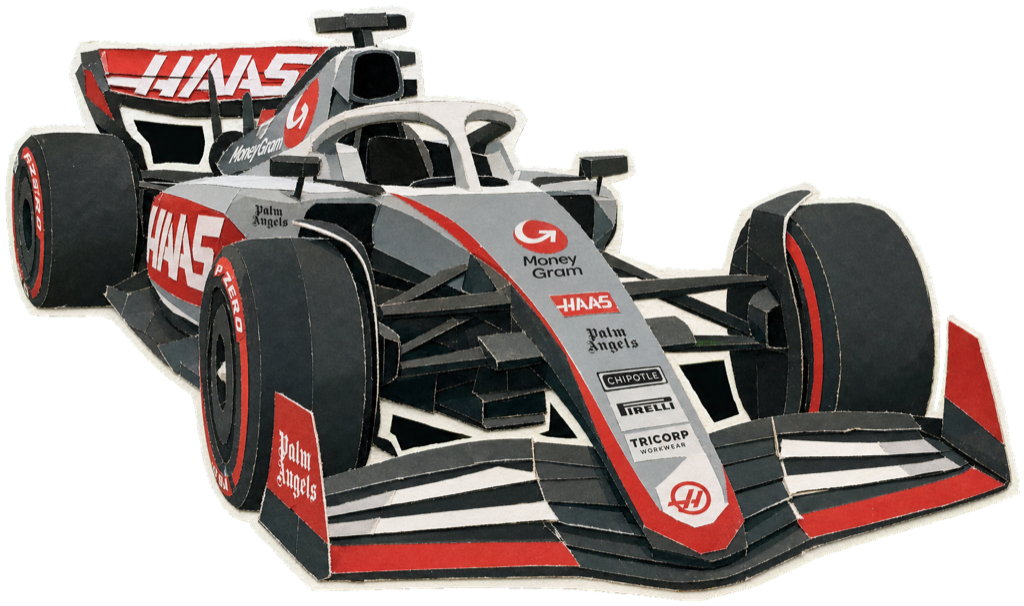
The engineering story
Work began in the second half of 2024 with a small concept group, ring-fenced from the points-scoring VF-25 until resources fully crossed over after the 2025 summer break 2. What emerged is, by De Zordo's own admission, a "base" car expected to be heavily updated through the year — but one with deliberate choices baked in.
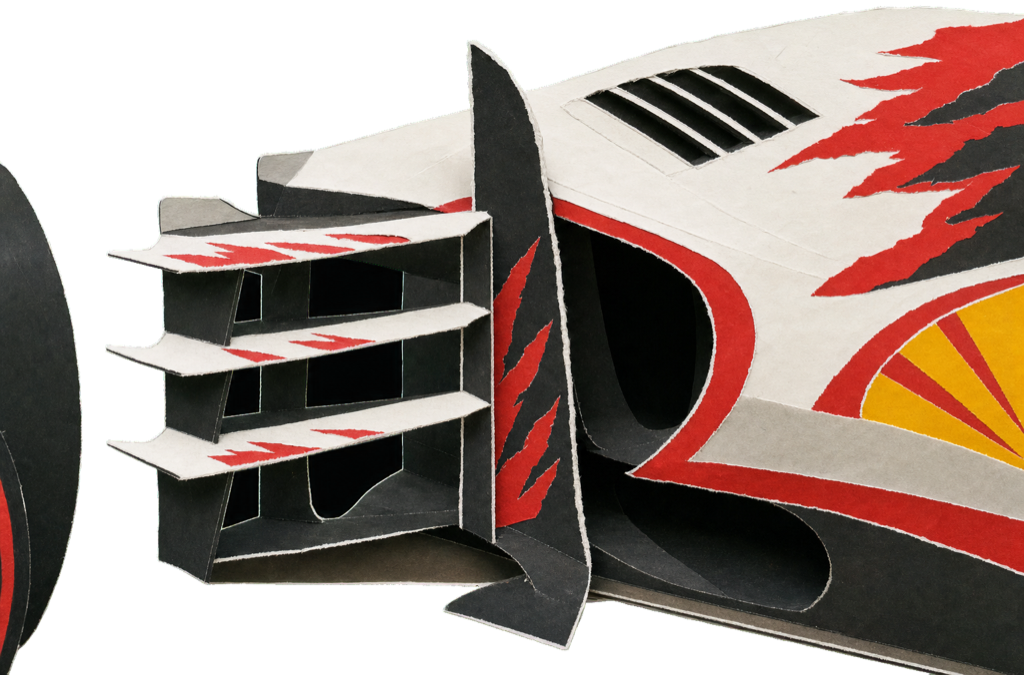
The most consequential mechanical call is the move to push-rod suspension front and rear, aligning Haas with Red Bull and Racing Bulls and away from the pull-rod orthodoxy of the ground-effect years 3. On a lighter car with narrower tyres, the push-rod layout buys a softer, wider operating window — useful insurance against the unknowns of the new formula. Aerodynamically, the front wing splits its endplate into two elements (a bent lower tray and a long horizontal blade) to maximise outwash and push air around the front wheel, while the nose reaches well past the mainplane with pillars doubling as flow diverters toward the floor inlet 3.
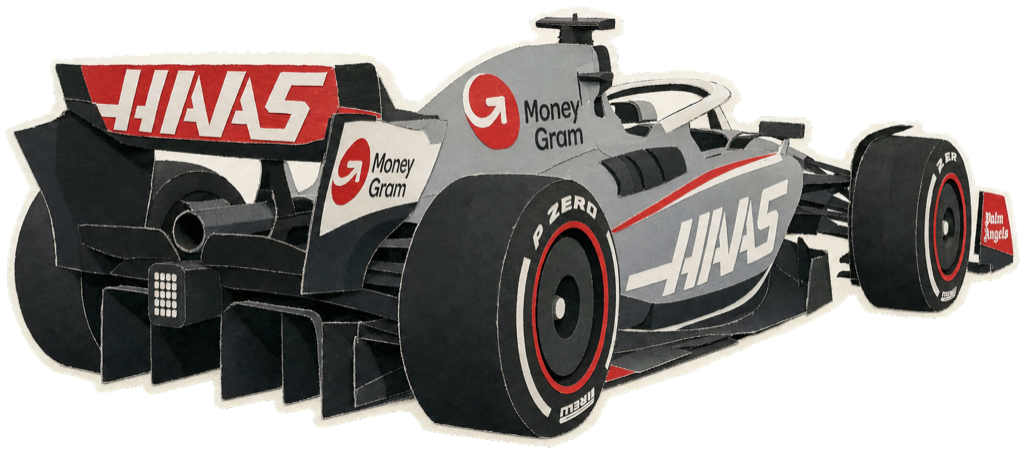
The car's signature visual flourish sits on its flanks: a segmented, three-bar lateral fence ahead of each sidepod inlet, backed by a tall vertical flow diverter, letting turbulent air spill outward rather than be ingested under the floor 3. The sidepods themselves carry a sculpted undercut feeding the diffuser and heat-venting louvres up top — a reminder that Ferrari's 2026 power unit concentrates heat along the car's sides.
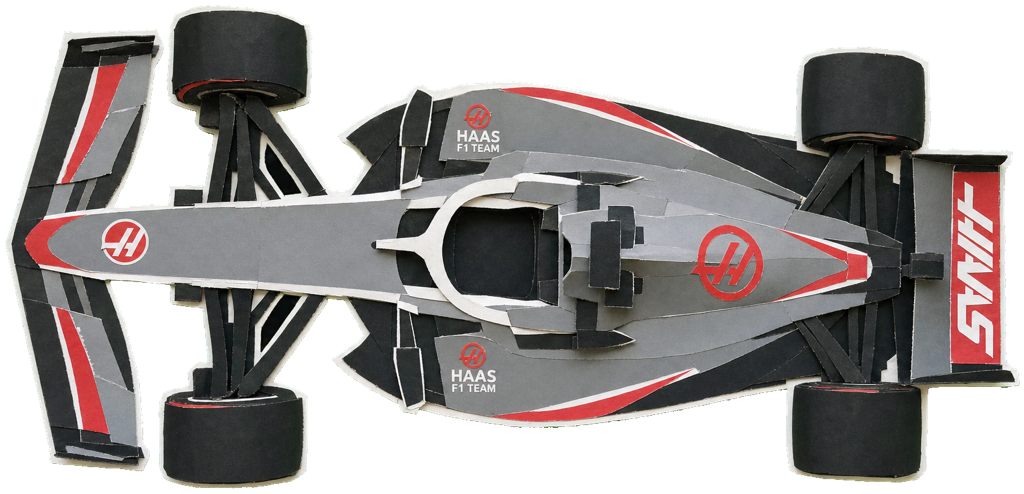
The Toyota dimension
The TGR partnership is more than a livery deal. Team Principal Ayao Komatsu has been explicit that Toyota plugs the gaps a rival engine supplier cannot: "certain areas in the regulation that Ferrari cannot help us because they are our competitor, and those are the areas where we are working together with Toyota" 10. Concretely, that has meant a new in-house simulator at Banbury, Haas's first full Testing of Previous Car programme (rebranded the TGR Haas Driver Development Program), and a "People, Product, Pipeline" framework expanding the team's engineering depth 910. For an outfit historically constrained by headcount and infrastructure, that is a genuine step-change in capability.
How the season went
On track, the VF-26 announced itself fast. Haas pumped in the second-highest mileage of any team across Bahrain testing — 794 laps — signalling rare early robustness 11. Then Oliver Bearman, the Ferrari junior in car #87, turned promise into points: seventh on debut in Melbourne, a sprint point and a fine fifth in China complete with a Q3 cameo, briefly vaulting him high in the drivers' table 1112. A heavy crash at Suzuka took some shine off, but the trajectory was clear — Bearman carried the bulk of Haas's early haul.
Esteban Ocon (#31), in his second Haas season, settled in more quietly: consistently into Q2, slightly shaded in qualifying, and finally on the board with P10 in Japan 1112. He has praised the new car's balance as having "huge potential." The emerging character of the VF-26 is a strong race-trim car that flatters its drivers on Sundays more than Saturdays, keeping Haas in a brutally tight "best of the rest" scrap with Alpine, Racing Bulls and Audi where, as Komatsu noted, only a handful of points separate fourth from seventh 1112.
Where it sits
The VF-26 is exactly what a well-run customer team should build for a rules reset: conservative where ignorance is expensive, sharp where it can afford to be, and oriented around extracting the most from Ferrari's new hybrid. With Toyota underwriting fresh infrastructure and Bearman emerging as a genuine midfield weapon, Haas opened 2026 punching above its weight — among the strongest starts in the team's history 12.
Key innovations
Designers & engineers
Sources & further reading
- Haas VF-26 — Wikipedia
- VF-26 Launch — Andrea De Zordo Q&A | Haas F1 Team
- F1 Tech: Inside the technical solutions shaping the new Haas VF-26 | GPblog
- VF-26 | Haas F1 Team (official car specifications)
- Andrea De Zordo — Wikipedia
- Q&A with Haas technical director, Andrea De Zordo — Pitpass.com
- TGR Haas F1 Team Reveals VF-26 Design & Livery | Haas F1 Team
- Haas confirms new F1 Technical Director to replace Resta — Motorsport Week
- Haas unveils striking VF-26 for F1 2026 as Toyota partnership begins — PlanetF1
- Revealed: What Toyota really wants to gain from its Haas F1 partnership — PlanetF1
- The state of play at Haas after three rounds of the 2026 season — Formula1.com
- Haas F1 2026 start: Oliver Bearman stars as team matches best-ever points haul — PlanetF1
Car renders are interpretive illustrations created for EXPO KINETIC, not photographs — approximate, for editorial use, not technical reference.