Car profile — 2026 season
Ferrari SF-26.
Maranello's clean-sheet answer to the 2026 reset: a glossy-red, all-pushrod challenger whose flip-over "Macarena" rear wing turns active aero into theatre — and that scored Lewis Hamilton's first win in Ferrari red.
A clean sheet for the biggest reset in a generation
The SF-26, internally Project 678, is the most important Ferrari in years — not because of incremental gains, but because 2026 tore up the rulebook. Narrower cars (1900mm wide, down 100mm), some 30kg lighter, an active aerodynamics package with movable front and rear wings, and a power unit philosophy rebuilt around a near-50/50 combustion-electric split on 100% sustainable fuel. For Maranello it was also the first full car penned under Loïc Serra, the French engineer recruited from Mercedes who took over chassis technical direction, working alongside power-unit chief Enrico Gualtieri and under team principal Frédéric Vasseur 128.
The brief was unambiguous: stop being the team that nails one-lap pace and throws away races. The SF-26 was conceived to be a more benign, more predictable platform than the pull-rod-fronted SF-25 that frustrated its drivers — and to claw back ground on a Mercedes power unit that Ferrari quietly conceded had a straight-line edge 37.
“Every 2026 car has active aero, but Ferrari's interpretation became the talking point of the season.”
The engineering story
The headline change is mechanical honesty at both ends of the car. Serra abandoned the troublesome front pull-rod layout and committed the SF-26 to pushrod suspension front and rear, packaging the front actuator at the head of the monocoque by routing the steering column behind the lower wishbone — a Mercedes-flavoured solution Serra knew intimately 42. The result, drivers reported, was cleaner steering feel on corner entry, the exact area where the previous car bit them.
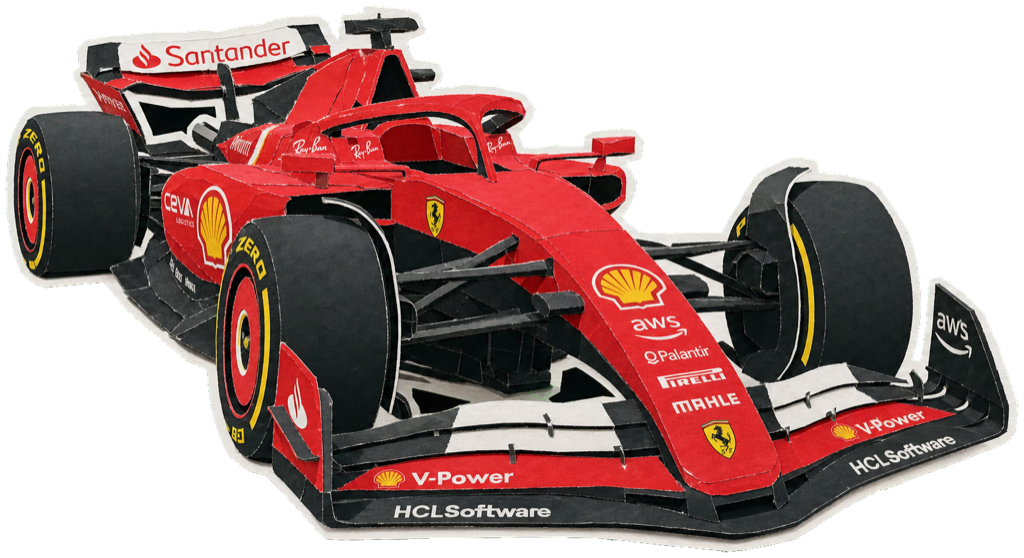
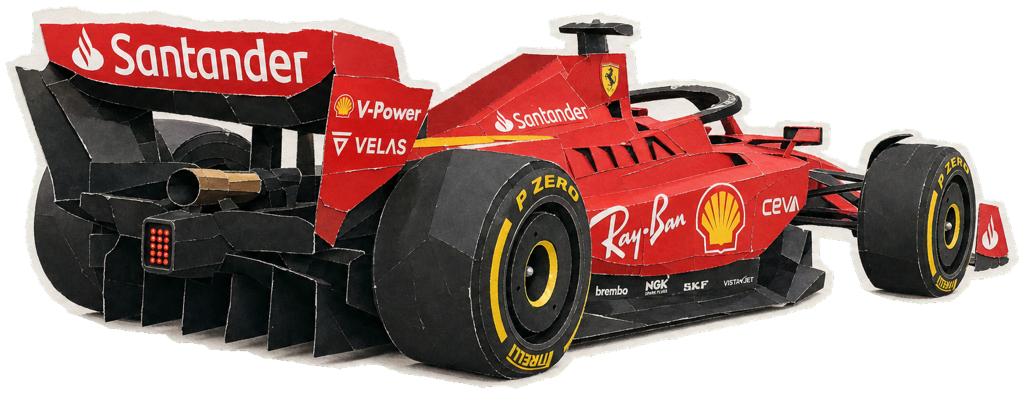
Behind the cockpit sits Gualtieri's 067/6: a 1.6-litre, 90-degree V6 single-turbo hybrid built to the new formula, with the MGU-H deleted and a vastly enlarged MGU-K deploying up to roughly 350kW, all on Shell's 100% sustainable fuel 15. The combustion side gives away a little to Mercedes, and much of the SF-26's aero concept exists to mask that — most visibly through its rear wing 3.
The Macarena
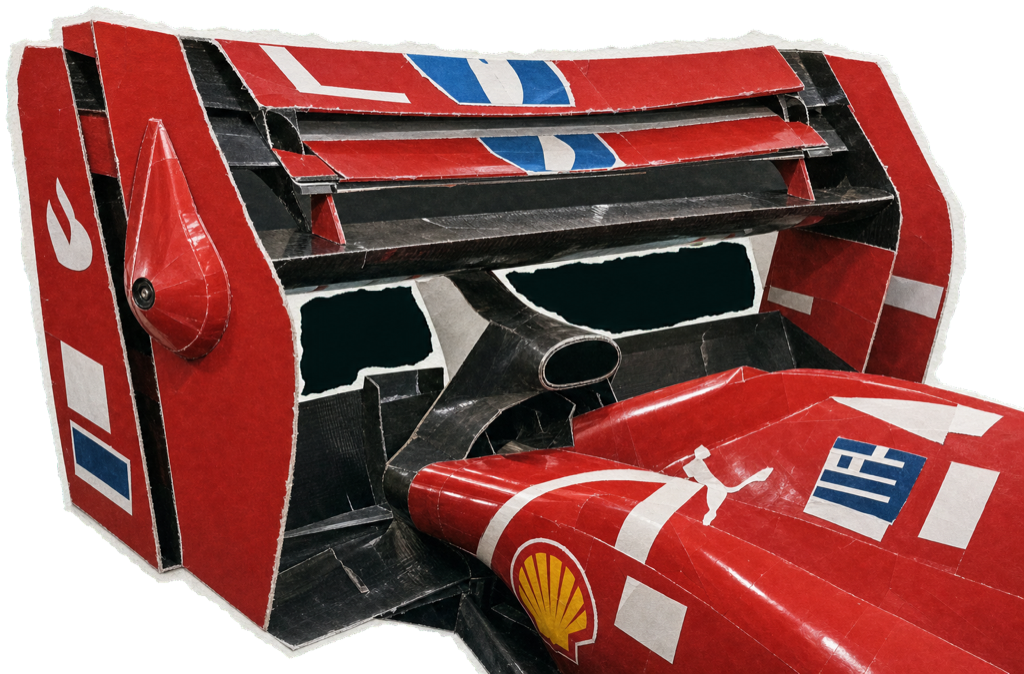
Every 2026 car has active aero, but Ferrari's interpretation became the talking point of the season. Nicknamed the "Macarena," the SF-26's triple-element rear wing doesn't merely open in low-drag mode — its upper two flaps rotate roughly 270 degrees and flip fully upside down, stalling the wing far more aggressively than a conventional flap 69. To make that physically possible, Ferrari removed the regulation single central actuator and relocated the mechanism laterally into a teardrop bulge on the endplate, with a backup actuator on the opposite side to restore downforce should the primary fail 9. The flip completes inside the FIA's four-tenths-of-a-second limit, is worth around 8km/h of top speed, and — in a neat bonus — passes through vertical on the way back to high-downforce mode, briefly acting as a parachute under braking 9. Up front, a movable two-element wing drops its flaps in sympathy, fed by high-pressure channels through the nose, the actuator buried inside the monocoque 10.
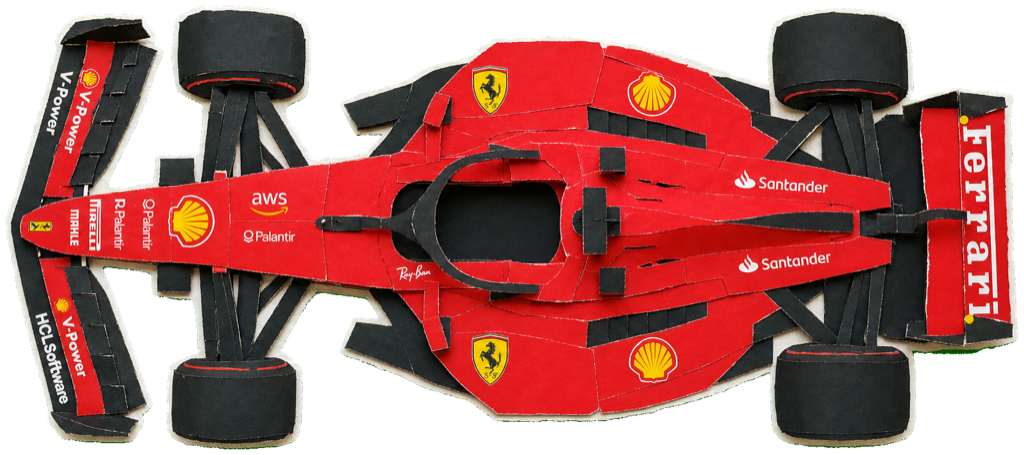
The aero group behind it — head of aerodynamics Diego Tondi with Franck Sanchez leading aerodynamic development, and the veteran Rory Byrne consulting — built the rest of the car to suit, including a Venetian-blind floor fence array and double-rib endplates that arrived with a substantial in-season "A-spec" upgrade around Miami 29.
How the season went
The car's competitiveness has been real but spiky. The defining moment came in Spain, where Lewis Hamilton took the SF-26's maiden victory — his first F1 win since 2021 — inheriting the lead through a perfectly-timed Virtual Safety Car and resisting to the flag, a hugely emotional result in his second Ferrari season 7. Around it came podiums in China, Canada and Monaco, plus a Ferrari 1-2 in Monaco practice that showcased the car's low-speed grip 2. There was pain too: Leclerc crashed at Monaco's final corner under a restart, red-flagging the race 2.
But the SF-26's Achilles' heel surfaced starkly in Austria, where both cars simply lacked race pace and finished well adrift of the winner, leaving Hamilton and Leclerc baffled and exposing how circuit-dependent — and power-sensitive — the package remains 3. The story of this car is the story of the 2026 reset itself: brilliant, innovative, theatrical in its active aero, and still chasing the consistency to turn a flip-over wing and a famous win into a title.
Key innovations
Ferrari SF-26 "Macarena" Rear Wing: The Upside-Down Active-Aero Flap
The "Macarena" (also "flip-flop" or "upside-down" wing), named by Ferrari team principal Fred Vasseur, is a radical interpretation of the 2026 active-aerodynamics rules in which the SF-26's upper rear-wing flap doesn't merely flatten for low-drag mode — it rotates roughly 270° until it is completely inverted, concave side down and convex side up, like an aircraft wing. This opens a much larger slot gap than a conventional flattened flap, slashing drag (and even generating a little lift to expand the diffuser) for a reported ~10 km/h straight-line gain. It exploits the fact that 2026 rules cap the open/close transition at 400ms but place no limit on rotation angle.
Under the 2026 technical regulations, F1 replaced DRS with full active aerodynamics: both front and rear wings have movable elements that switch between a high-downforce "Z-mode" (cornering grip) and a low-drag "X-mode"/Straight-Line Mode (top speed) on designated parts of the lap 127. A conventional 2026 active rear wing simply flattens its upper flap toward horizontal to shed drag on the straights 37.
Ferrari went further. Instead of stopping at flat, the SF-26's upper flap keeps rotating — roughly 270° clockwise — until it ends up completely upside down, with the normally-concave (pressure) side now facing the ground and the convex side facing the sky 456. In normal downforce mode the flap's upper surface has a smaller area than its underside, generating the pressure difference that makes downforce; when the flap inverts, that smaller surface becomes the lower one, so it "creates more space in the gap than in a conventional flattened (but not upside-down) flap," per Mark Hughes' F1 analysis 37. The bigger slot gap lets far more air pass through, dramatically reducing drag — and the inverted profile behaves like an aircraft wing, producing a touch of lift that raises the rear, subtly expanding the diffuser's expansion volume and trimming tyre rolling resistance 45. GPS traces showed Hamilton gaining about 10 km/h in Shanghai when the system deployed 8.
This is legal because the 2026 rules cap only the transition time between the two fixed positions at 400ms and set no limit on rotation angle 39. Mechanically it differs from a normal active wing too: Ferrari deletes the single central actuator and instead drives the flap with twin actuators hidden inside reinforced endplates, giving the 270° travel 56. A neat side-effect is that during the return to downforce mode the flap briefly passes through vertical, acting like a parachute/air-brake on corner entry 2. Red Bull's Miami copy works differently — it keeps the central actuator and rotates only ~110-120° in the opposite direction, with an even bigger but cruder gap 56.
How it arrived
- Pre-season testing (Feb 2026)Team principal Fred Vasseur nicknames the rotating wing the 'Macarena' (also dubbed 'flip-flop' / 'upside-down' wing) in the paddock.
- Feb 19, 2026 - Bahrain Test, Week 2, Day 2First run on track: Lewis Hamilton laps in and out of active-aero zones, completing about five laps with the wing flipping the IBM logo upside down on the straights.
- Late Feb 2026 - Bahrain final testFerrari also debuts the related 'FTM' exhaust-blown mini beam-wing winglet behind the exhaust, exploiting a rearward differential/diffuser package.
- Round 1 - Australian GP (Melbourne)Macarena wing NOT fitted; remained a development item.
- Chinese GP (Shanghai) - Friday practiceFirst official-session use: Leclerc and Hamilton run it in the only free practice (5th/6th fastest), then remove it before sprint qualifying over rear-stability and reliability concerns; Hamilton says it was rushed and meant for ~race four or five.
- Japanese GP (Suzuka)Ferrari refines the concept and signals its return after the China setback.
- Miami GPVasseur confirms 'From today we will keep the Macarena on the car' — first race deployment on both cars; Red Bull arrives with its own similar upside-down wing for Friday practice.
- From Miami onward (2026 season)Macarena kept on the SF-26 and evolved to 'Macarena 2.0' (revised actuators, sturdier pylons, squared-off endplate leading edges).
- By ~early May 2026Rivals copy the related flow-turning/exhaust concept — Haas (China), then McLaren, Mercedes, Red Bull, Williams, Alpine and Cadillac after Japan; FIA opens discussions about clamping down on exhaust-area aero for 2027.
Designers & engineers
Sources & further reading
- Ferrari SF-26 — Wikipedia
- How Ferrari's new chain of command is shaping SF-26 development — ScuderiaFans
- Why Ferrari went from winning in Spain to struggling in Austria: the hidden weakness of the SF-26 — ScuderiaFans
- Ferrari copies Mercedes suspension concept on SF-26 to unlock performance gains — ScuderiaFans
- SF-26, The New 2026 Ferrari Single-Seater — Ferrari.com
- Tech: The unique Ferrari 'Macarena' F1 rear wing explained — Motorsport Week
- Hamilton's First Ferrari Win: 2026 Spain GP Recap — 123Helmets
- Who is Franck Sanchez? Meet Ferrari's new F1 aerodynamicist — ScuderiaFans
- Ferrari ready to debut 'Macarena' rear wing: how it works and why it boosts the SF-26 — ScuderiaFans
- Ferrari SF-26 front wing secret revealed: the key component explained — ScuderiaFans
Car renders are interpretive illustrations created for EXPO KINETIC, not photographs — approximate, for editorial use, not technical reference. The Macarena-wing explainer frames are stylised from public reference photography.