Car profile — 2026 season
Cadillac MAC-26.
Formula 1's brand-new 11th team arrives with American ambition, a Ferrari heartbeat and a name that honours Mario Andretti — the MAC-26 is a debut car built to survive 2026's great reset and lay the groundwork for a GM works engine in 2029.
The brief: build a real Formula 1 team from a blank sheet
No car on the 2026 grid carries a heavier symbolic load than the Cadillac MAC-26. It is the first machine of Formula 1's brand-new 11th team — a works project backed by General Motors and TWG Global that grew out of the Andretti bid first launched in 2022 12. That bid was approved by the FIA in 2023, blocked by the commercial rights holder, and only finally waved through in March 2025 once GM committed to a full works engine programme 2. The brief, then, was uniquely brutal: design a competitive car to the most radical rule reset in a generation while simultaneously hiring a workforce, standing up factories in Fishers, Indiana and Silverstone, and proving that an American outsider belonged.
The name says everything about the project's emotional charge. MAC-26 stands for "Mario Andretti Cadillac," honouring the 1978 World Champion and Indy 500 winner whose advocacy was instrumental to the entry 37. Revealed on 27 February 2026, the day before Andretti's 86th birthday, the badge prompted team principal Graeme Lowdon to recall that "at the start of my own journey with the team, he asked me not to let him down" 7.
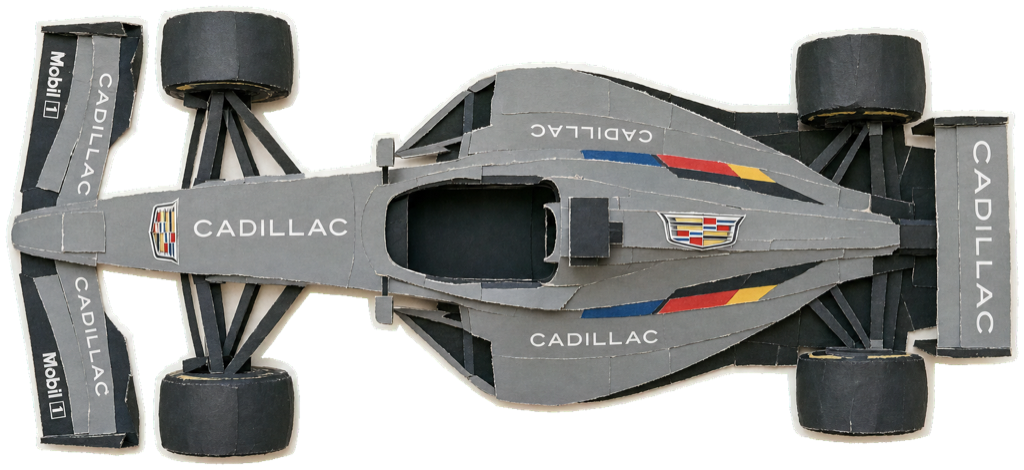
“A predominantly white symmetrical revision followed later in the year after positive fan feedback.”
The engineering story: Ferrari's heart, Cadillac's hands
For 2026 the entire sport tore up the book. Cars are narrower (max width 1900mm, down from 2000mm), some 30kg lighter (a 768kg minimum including the driver), and run a new 1.6-litre V6 turbo-hybrid with roughly a 50/50 split between combustion and electrical power, the MGU-H deleted, the MGU-K's deployment raised toward 350kW, and 100% sustainable fuel 8. DRS is gone, replaced by active front and rear wings toggling between a high-downforce "Z-mode" and a low-drag "X-mode" 8.
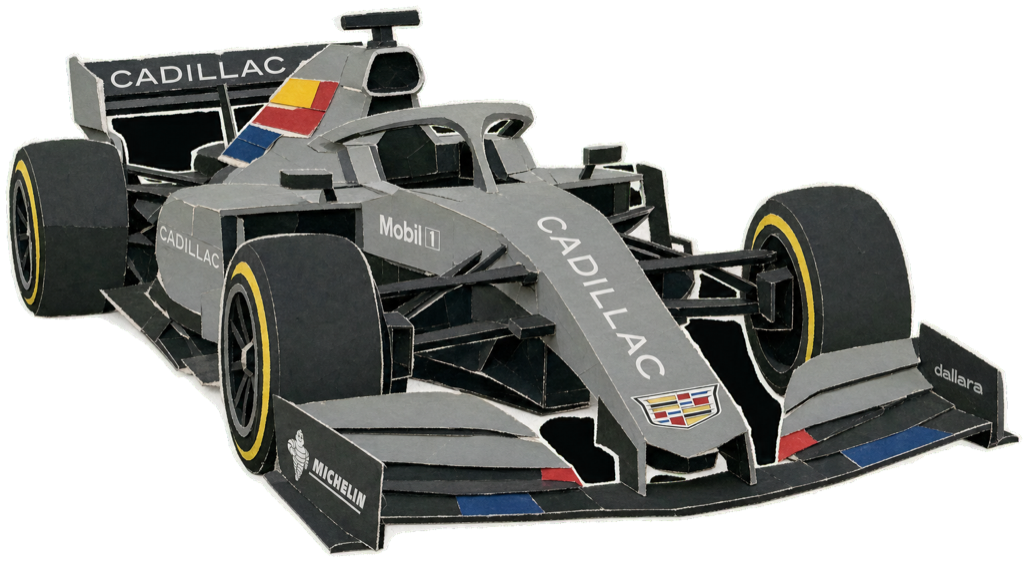
Into this Cadillac slotted a Ferrari power unit — the 2026-spec Tipo 067/6 — plus Ferrari gearbox internals, but mounted in a gearbox casing Cadillac designs and builds itself 4. That casing independence is no detail: it preserves the team's freedom to shape its own rear aerodynamics, and it is a deliberate bridge to the in-house General Motors works engine targeted for 2029 18.
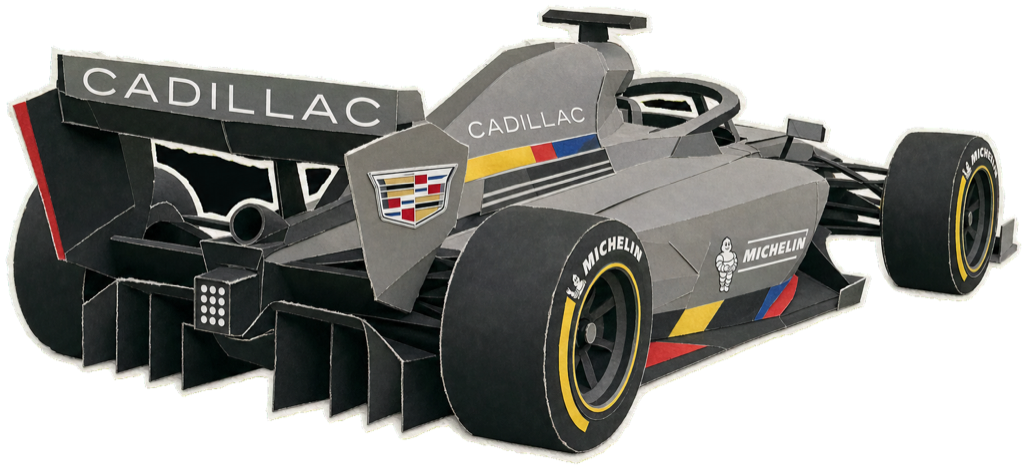
The car itself is the work of a deep technical roster led by chief technical officer Nick Chester, with the vastly experienced Pat Symonds as executive engineering consultant. The design credits also list chief designer John McQuilliam, deputy chief designer Rob Stubbings, aero head Jon Tomlinson, and senior figures Simon Dodman and James Knapton 3. It is, pointedly, a who's-who of British single-seater engineering — the substance behind an American marque.
The innovations: where the MAC-26 stands apart
When independent analyst Gary Anderson studied the launch car, he came away impressed — and called it "a step ahead of most its rivals, who have yet to turn a wheel in anger" 5. Two choices stood out. First, the pull-rod front suspension, a layout Cadillac shares with only Alpine on the 2026 grid. Anderson approved: the inboard components sit lower for a reduced centre of gravity, and the pull-rod's slimmer cross-section means less aerodynamic blockage, while the top wishbone geometry delivers significant anti-dive for the heavier braking the new cars demand 5. Second, the cooling architecture: a high, horizontal "letterbox" radiator inlet with a vertical opening feeding a steeply falling upper sidepod and a deep undercut — a properly aggressive packaging statement for a first car 5. Anderson even singled out a horizontal winglet on the outer upper edge of the front-wing endplates as a genuinely new development frontier for 2026 5. At the rear, a push-rod inboard mechanism with anti-lift geometry completes the picture 45.
The look, and the season
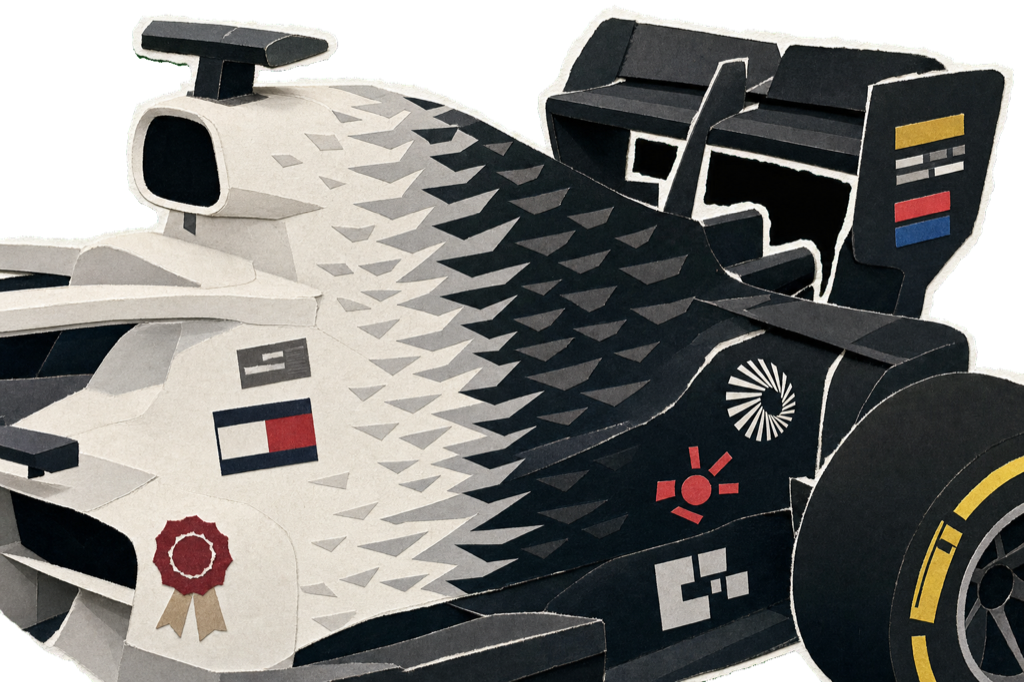
The MAC-26 announced itself with a livery unlike anything else on the grid, revealed in a Super Bowl LX commercial in February 2026 6. The car is two-sided: greyish-white on the left, black on the right, the boundary feathered into a gradient built from a repeating Cadillac chevron motif that fakes motion even at a standstill 6. Notably, Cadillac arrived as the only 2026 team without a title sponsor, its flanks instead carrying TWG, Tommy Hilfiger, Jim Beam, Claro, IFS and Pirelli 6. A predominantly white symmetrical revision followed later in the year after positive fan feedback.
On track, reality bit hard. With two grand-prix winners — Sergio Pérez (#11) and Valtteri Bottas (#77), together holding 16 wins and over 500 starts 9 — Cadillac had experience, but a brand-new car, engine and organisation is a mountain. The team ran near the back and was dogged by reliability problems, finishing only a handful of the opening races. Miami brought a genuinely encouraging upgrade that worked as intended 10. Then came a chastening Austrian Grand Prix: Bottas out after two laps, Pérez after four, both with brake failures, the drivers conceding "we cannot have these sort of issues" 11.
Where it sits
Judged on points, the MAC-26 is a tail-ender. Judged on its actual brief — to exist, to be credible, and to seed something far bigger — it is a remarkable first effort. Anderson's verdict that the car looked ahead of some established rivals at launch is the truest measure of Cadillac's debut: not a vanity entry, but the foundation of a works programme aiming at its own American engine by 2029 58.
Key innovations
Designers & engineers
Sources & further reading
- Cadillac MAC-26 — Wikipedia
- Cadillac in F1 explained: everything you need to know about Cadillac's 2026 entry — Formula1.com
- Cadillac F1 Team Guide 2026 — TracksideCulture / Wikipedia design credits
- F1's 2026 liveries and tech-spec round-up — Race Tech Magazine
- Gary Anderson's verdict on the 2026 F1 car Cadillac debuted — The Race
- Cadillac F1 livery: all the names and sponsors — GM Authority / Motorsport.com two-sided livery reveal
- Cadillac names its first F1 car MAC-26 after Mario Andretti — The Race
- 2026 regulations explained: F1's new power units — Formula1.com
- Cadillac F1 sign Pérez and Bottas for debut 2026 campaign — Sky Sports
- Valtteri Bottas' unusual Miami F1 penalty explained as Cadillac makes progress — Motorsport.com
- 'We cannot have these sort of issues' — Pérez and Bottas reflect on Cadillac's Austrian GP problems — Formula1.com
Car renders are interpretive illustrations created for EXPO KINETIC, not photographs — approximate, for editorial use, not technical reference.