Cars › Aston Martin › AMR26
Car profile — 2026 season
Aston Martin AMR26.
Adrian Newey's first Aston Martin is the grid's most extreme 2026 car — a tube-sidepod, pelican-nosed Honda works machine whose engineering ambition has so far been throttled by a violently vibrating power unit.
The brief: Newey's blank sheet for a new era
The AMR26 carries more expectation than any car Aston Martin has built. It is the first machine designed under Adrian Newey, who joined the Silverstone squad as Managing Technical Partner after his long Red Bull tenure, and it arrives in the season of Formula 1's biggest rules reset in a generation. Everything changed at once for 2026: cars narrowed to a 1,900mm maximum width and shed around 30kg to a 768kg minimum, active front and rear wings replaced DRS with switchable high-downforce "Z-mode" and low-drag "X-mode" states, and the power units became 1.6-litre V6 turbo-hybrids splitting their output roughly 50:50 between combustion and electrical energy, with the MGU-H deleted, MGU-K output pushed up to around 350kW, and 100% sustainable fuel mandated. 56 For Aston Martin the reset coincided with becoming a full works team for the first time, pairing an in-house Aston Martin chassis and gearbox with a works Honda power unit, Aramco's sustainable fuel and Valvoline lubricants. 38
The design story: extreme by choice
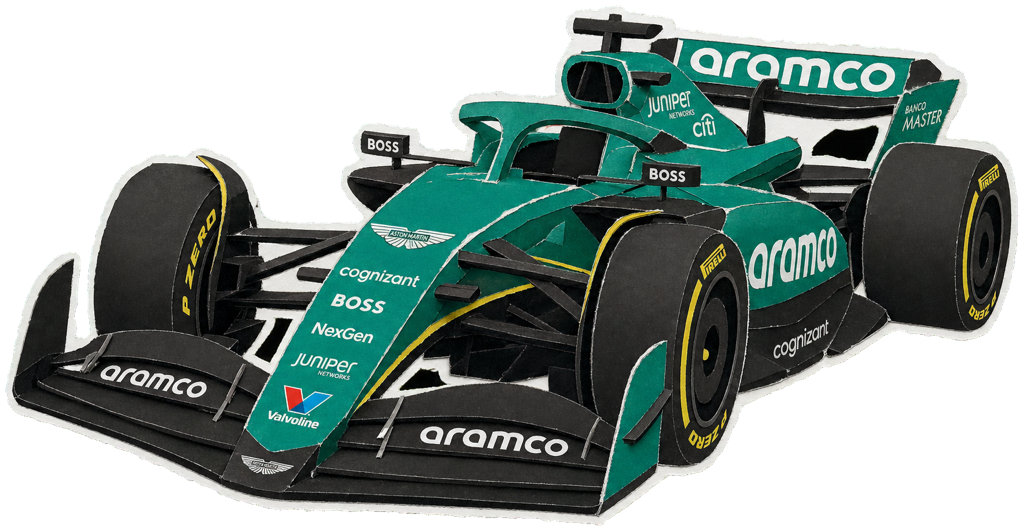
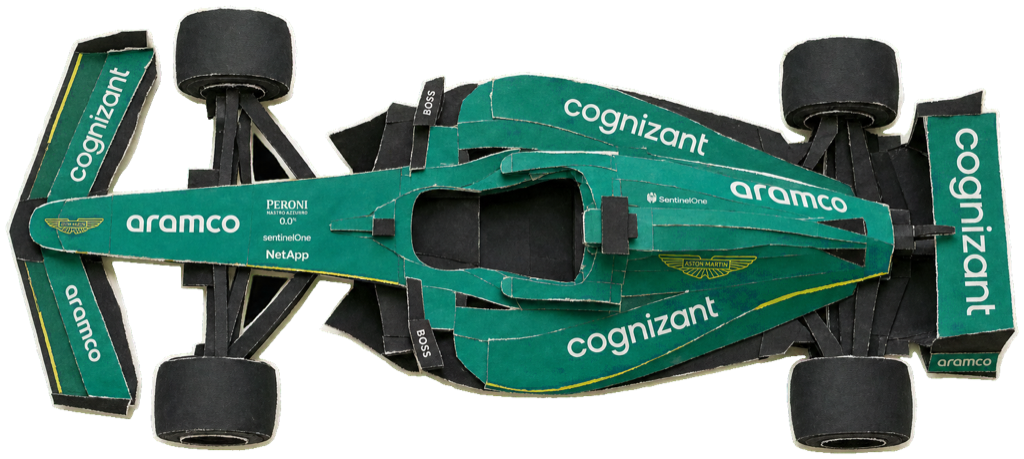
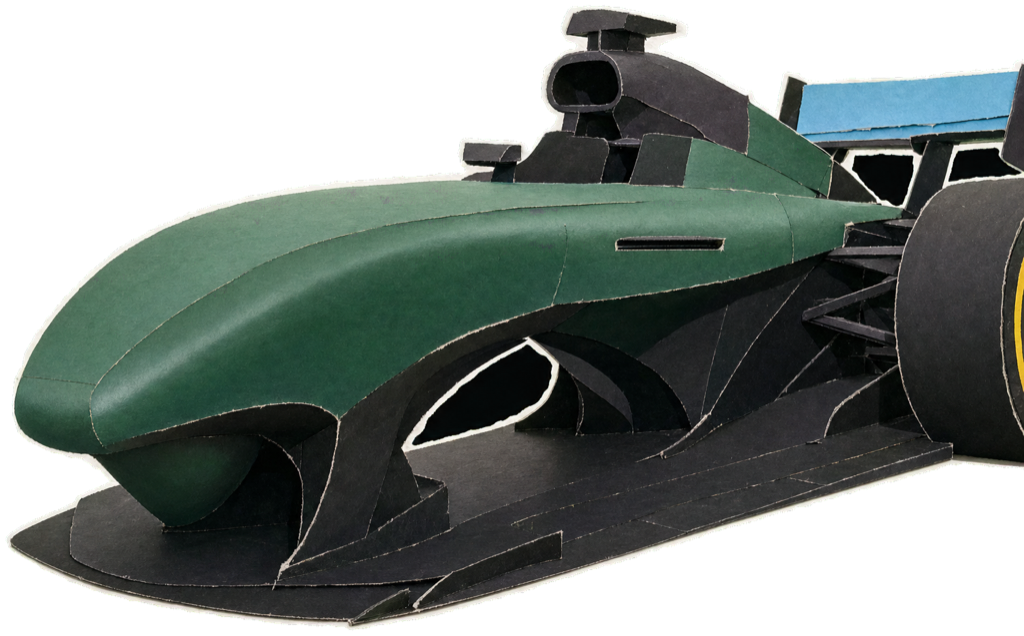
When the matte British-Racing-Green car broke cover — its livery unveiled on 9 February 2026 at the Ithra cultural centre in Dhahran, Saudi Arabia, in partnership with title sponsor Aramco — the AMR26 immediately stood out as the most radical interpretation of the new rules. 21 Technical analysts reached for Newey's back catalogue to describe it. The sidepods looked "more like tubes than pods," fed by tiny near-horizontal radiator inlets and carved away underneath by an undercut that Giorgio Piola and others called unmatched on the grid. 47 The pods stop well short of the floor, opening a vast expanse of floor to channel air between the diffuser wall and the rear tyre. At the front sat a distinctive "pelican" nose — wide as Red Bull's, with a rounded underbelly bulge giving way to a slender profile that feeds air beneath the centreline. 4
“What no one anticipated was that the headline problem would come from the engine bay, not the wind tunnel.”
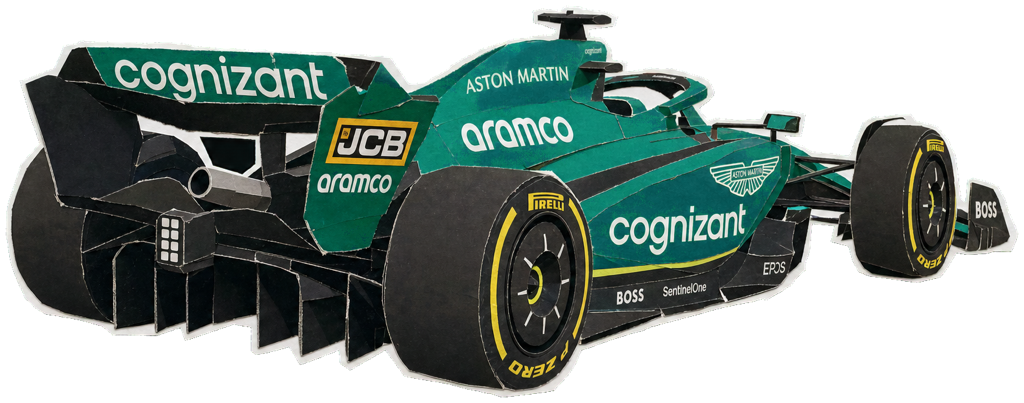
Underneath, Newey went further still. The AMR26 uses "monolithic" single-piece wishbones — one structural arm spanning pickup to pickup — at both ends, the first time he had deployed the idea so extensively, paired with a multi-link front layout echoing the Red Bull RB15 and a squared-off front bulkhead. 79 The rear suspension drew the most admiration: the upper pushrod arms mount incredibly high and attach near the centreline by the rear-wing pylon, leaving the diffuser exit strikingly clear and, analysts suggested, helping redirect exit flow toward the rear-wing underside as a partial replacement for the banned beam wing. 94
The trade-off: genius with no margin
Newey was candid that he had prioritised fundamentals and development headroom over an immediately optimised package, warning against "a car that comes out quite optimised within its window but lacks a lot of development potential." 10 Yet the irony of the AMR26 is that its extremity cut both ways. The bodywork clings to the mechanicals as a millimetre-thin skin, with internal elements packaged so tightly that meaningful changes are nearly impossible without altering external shapes — a car, in Piola's framing, with "no room left to make adjustments." 114 It is a recurring Newey signature: maximum aerodynamic ambition, minimum practical slack.
The crisis: a power unit that shook the car apart
What no one anticipated was that the headline problem would come from the engine bay, not the wind tunnel. From shakedown onward the Honda RA626H suffered severe vibrations. Honda confirmed the oscillations were damaging the battery system, and the harshness was bad enough that drivers reportedly lost feeling in their hands within around 15 laps, raising genuine fears of nerve damage. 1 The root cause was traced to a complex interaction between the combustion engine, chassis integration and the very compact packaging concept Aston Martin had requested — a pointed illustration of how the team's extreme architecture and Honda's new unit collided. 1 Honda was rebuilding its F1 effort under the new rules, and the early reliability deficit showed: the AMR26 ran lower test mileage than rivals and suffered multiple breakdowns. 1
How the season has gone
The consequences were brutal at first. The car race-debuted in Australia, where neither machine was classified — Alonso retired after a spirited opening-lap charge, undone by the vibration problem, and the issues persisted into the following round. 1 The breakthrough came at Honda's home race in Japan, where a mitigation component trialled in Friday practice largely cured the vibrations; Alonso brought the car home to record Aston Martin's first classified finish of the season. 1 From there, reliability and competitiveness gradually improved through the European rounds as the team began to access the chassis' obvious potential, though development remained an uphill task given how little internal margin the design left. 11
Where it sits
The AMR26 is best read as a high-variance bet. It pairs arguably the most talented design mind of the modern era, a two-time champion in Fernando Alonso (#14) and a fully resourced works alignment with Honda, Aramco and Valvoline against a debut season defined first by a power unit that quite literally shook the car — and the drivers — to their limits. 18 The engineering ambition is not in doubt; whether Newey's extreme concept can be developed quickly enough to convert paddock admiration into results is the defining question of Aston Martin's new era.
Key innovations
Designers & engineers
Sources & further reading
- Aston Martin AMR26 — Wikipedia
- Aston Martin Aramco launches season with livery reveal — Aston Martin F1 Team
- 2026 AMR26 | F1 Machines Powered by Honda — Honda Global
- TECH ANALYSIS: Why Adrian Newey's first Aston Martin design has caused a stir — Formula1.com
- F1 2026 | A new era — Aston Martin F1 Team
- Honda Reveals RA626H Power Unit at Tokyo Partnership Launch Event — Honda Racing
- Aston Martin AMR26: monolithic wishbone arm and extreme chassis — Giorgio Piola Design
- Aston Martin reveals F1 2026 livery for Newey-designed AMR26 — Motorsport.com
- TECH WEEKLY: Inside the extreme approach of Newey's Aston Martin AMR26 design — Formula1.com
- Aston Martin AMR26: What we're hearing about Adrian Newey's F1 2026 car design — PlanetF1
- F1, Newey too extreme: uphill development for the Aston Martin AMR26 — Giorgio Piola Design
- Honda explains Aston crisis as battery flaw exposed — GrandPrix.com
Car renders are interpretive illustrations created for EXPO KINETIC, not photographs — approximate, for editorial use, not technical reference.