Car profile — 2026 season
Alpine A526.
Enstone's defiant reboot: a Mercedes-powered, pull-rod, contrarian-winged A526 that closes the Renault works-engine era and drags Alpine back off the bottom of the grid.
A clean break with Viry
The A526 is the car with which Enstone finally let go of its own engine. After Renault wound down its Viry-Châtillon power-unit programme through 2025, Alpine arrived at Formula 1's 2026 rules revolution as a customer team for the first time in the modern works era, bolting a Mercedes-AMG power unit and gearbox into the back of a car designed from a blank sheet around the new formula. 13 It is, the team is keen to point out, the first Enstone car to carry Mercedes power since the 2015 Lotus E23 Hybrid — a neat historical bookend that closes the Renault works chapter even as the squad keeps the French marque's blue. 7
The brief for 2026 was unusually stark. Alpine had spent the previous season at the bottom of the constructors' table, a campaign effectively sacrificed to throw resources at this all-new rulebook. "If the car is bad, it is our fault," executive adviser Flavio Briatore said at the launch. "We did not have any problems building this car." 9 The pressure for visible progress, in other words, was self-imposed and total.
“The single defining engineering reality of the A526 is that it was conceived around hardware Enstone does not build.”
Designed around someone else's engine
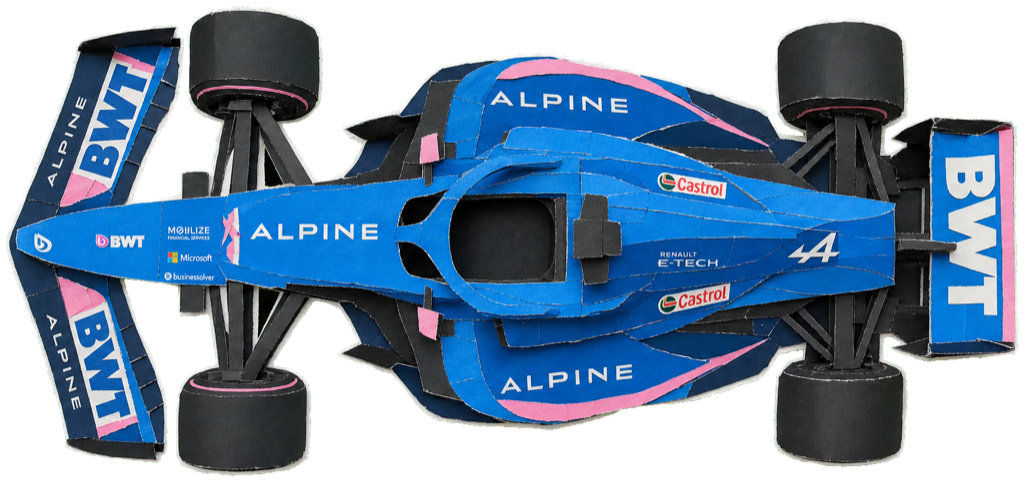
The single defining engineering reality of the A526 is that it was conceived around hardware Enstone does not build. Under the 2026 regulations — 1.6-litre V6 hybrids with the MGU-H deleted, a roughly 50/50 combustion-to-electric power split, MGU-K deployment up to about 350kW and 100% sustainable fuel — energy deployment, cooling and packaging are more tightly interwoven with aerodynamics than ever. 3 Alpine's answer was to package the car so it looks built around the Mercedes installation rather than adapted to it: an unusually long, tapered sidepod with the radiator inlet pushed far forward of the mandatory side-impact spur, feeding the German cooling demands while keeping the rear end tight. 59
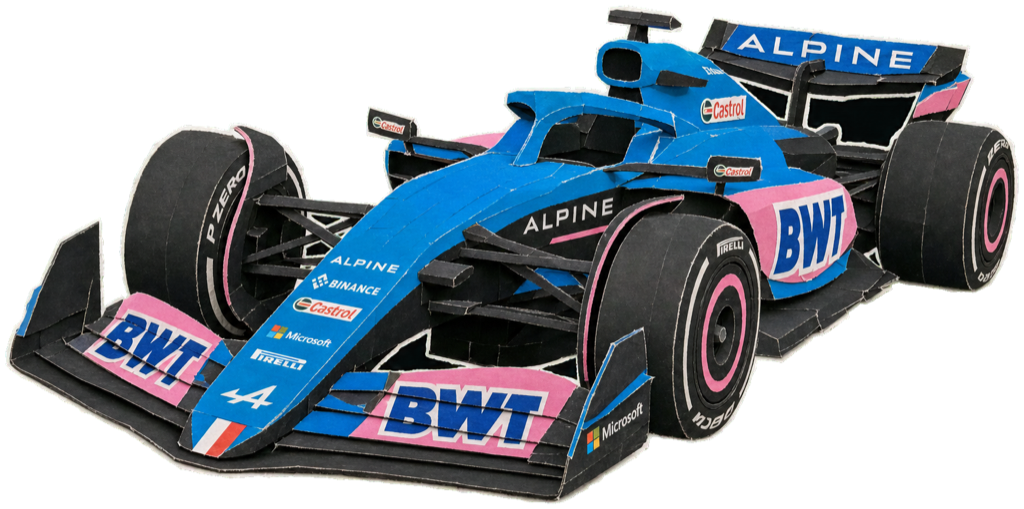
The platform also shrank to suit the new dimensional limits — roughly 200mm shorter and 100mm narrower than its predecessor, and around 30kg lighter, down to the 768kg minimum that now governs the smaller, more agile 2026 cars. 1
Enstone's contrarian streak
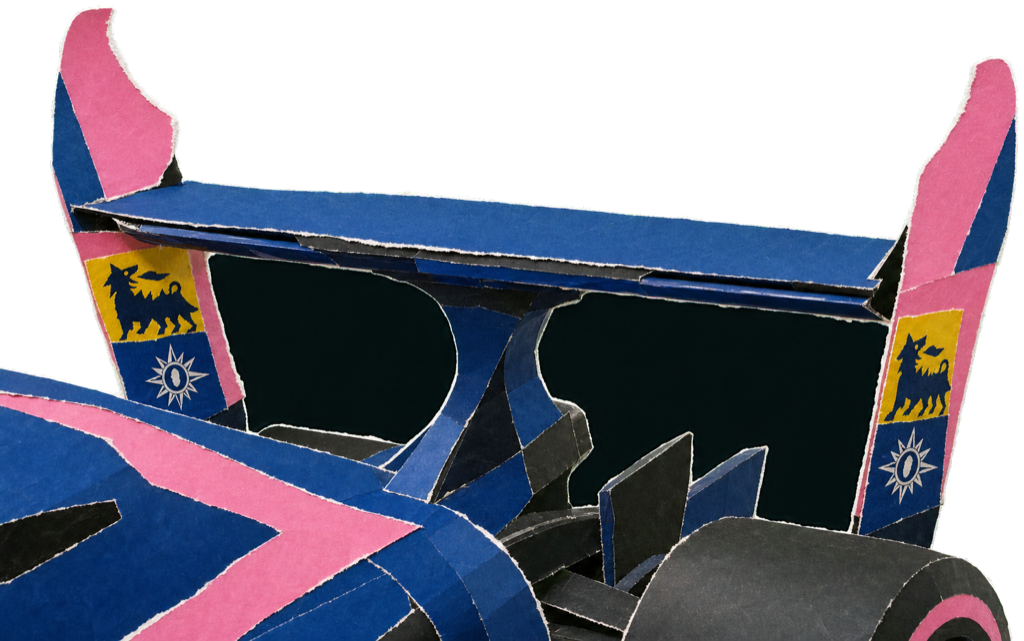
Where the A526 gets genuinely interesting is in its aerodynamics, overseen by executive technical director David Sanchez. With 2026 mandating active front and rear wings that toggle between a high-downforce "Z-mode" and a low-drag "X-mode," every team had to invent a movable-wing mechanism — and Alpine chose to do it backwards. Rather than opening a DRS-style flap by lifting its leading edge, the A526's rear-wing element flattens by dropping its trailing edge, collapsing the two elements into one long, near-flat blade for straight-line mode. 58 It is a fundamentally different reading of the rules from anyone else on the grid.
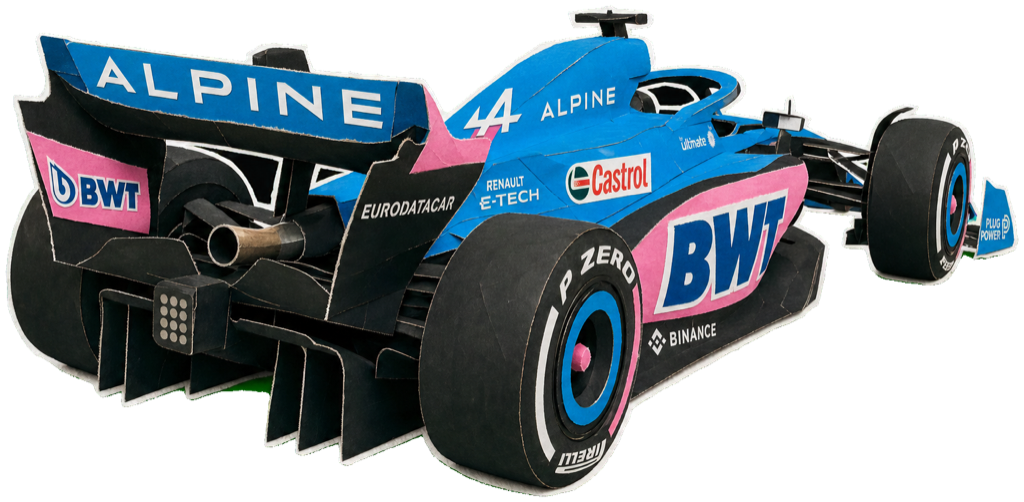
That headline trick sits alongside a cluster of equally unorthodox choices: rear-wing endplates curved outward at the top to claw flow capacity out of the shrunken regulatory wing box; flow-conditioner vanes revived under the front wing, echoing concepts banned under the old rules but legal again now; and, most strikingly for a front-running aspiration, pull-rod front suspension. 25 McLaren, Red Bull and Ferrari have all abandoned front pull-rods; Alpine joined only newcomer Cadillac in keeping the layout, accepting its trickier geometry in exchange for a lower spring/damper installation and cleaner upper-body airflow. 25 It is the kind of curious, against-the-grain interpretation that has been an Enstone trademark since the Benetton and Renault title years.
The leadership and the cast
Sanchez leads a restructured technical group that splits responsibility three ways: Joe Burnell as technical director for engineering, Ciaron Pilbeam as technical director for performance, with Michael Broadhurst as chief aerodynamicist and Yannick Ducret heading aerodynamics performance and science. 12 Above them all sits Briatore, back as the squad's executive adviser and de facto principal after the 2025 upheaval that saw Oliver Oakes depart. 9
In the cockpit, Pierre Gasly (#10) is the team leader and reference point, partnered by Argentina's Franco Colapinto (#43), promoted to a full seat after standing in during 2025. 19 The pairing was unveiled, with the car's "Driving Pink Change" BWT livery, in one of the season's more theatrical launches — aboard the MSC World Europa cruise ship off Barcelona in January. 46
How the season has gone
The early evidence is that the gamble worked. After finishing dead last in 2025, Alpine immediately looked like an upper-midfield car. Gasly has been the standout, scoring through the opening rounds — sixth in China, seventh at Suzuka — and in China the team brought both cars home together for the first time in an age, Colapinto taking his maiden Alpine point in tenth. 10 Colapinto then logged a career-best seventh at Miami. 1 The campaign's most bittersweet moment came at Monaco, where Gasly ran third after passing Isack Hadjar at a red-flag restart, only for two pit-lane speeding penalties to demote him to seventh — a podium that was there and then wasn't. 11
For a team that had hit rock bottom, the A526 represents exactly what the 2026 reset was supposed to offer: a chance to start again, this time with the sport's benchmark engine in the back and an aero department willing to do things its own way. Whether the contrarian wing and pull-rod front prove inspired or merely brave will define the rest of Enstone's Mercedes era.
Key innovations
Designers & engineers
Sources & further reading
- Alpine A526 — Wikipedia
- Alpine A526 — Wikipedia (technical specifications)
- Alpine's A526 built around Mercedes power as team tackles F1's complex 2026 regulations — Motor Sport Magazine
- Driving Pink Change: BWT Alpine F1 Team unveils the A526 livery — Alpine global media
- Alpine's innovative 2026 F1 rear wing explained — Autosport
- Alpine reveals 2026 F1 livery in launch on boat — The Race
- Alpine F1 2026 Preview: A526, Mercedes Power and Bahrain Testing Insights — TheSportsSide
- Alpine's unconventional 2026 rear wing system breaks with F1 tradition — F1Place
- Alpine A526 launch: Briatore reveals heightened expectations — Sky Sports F1
- Gasly sixth in China, Colapinto scores first point — Les Alpinistes
- Gasly's podium lost at Monaco 2026 — Les Alpinistes
Car renders are interpretive illustrations created for EXPO KINETIC, not photographs — approximate, for editorial use, not technical reference.